1.1.3 Managing the information and knowledge
By the late 70s and the early 80s, the economic theory started to give information a leading role in the economic analysis in general, and in the study of monopolist regulation in particular. In this sense, Laffont (1999) pointed out two important theoretical bases.96 In 1979, Loeb and Magat proposed to view regulation as a contractual relationship in which the regulator (the principal) attempts to control a firm (the agent) and they emphasized that, in that relationship, the main difficulty was the regulator's lack of information about the regulated firm.97 In 1982 Baron-Myerson showed that there was a trade-off between efficiency and the unavoidable informational rents that must be given up to the regulated firm, when the regulator wants a project to be realized but does not know the cost of the regulated firm.98
Since then, regulation has been characterized by economists as a game between the regulator and the regulated firm in which the two players do not share the same information. Therefore, the regulatory agency, which is responsible for the analysis and the evaluation of the regulated firms' performance, must design and implement systems to generate information and resort to mechanisms that encourage the disclosure of truthful information for mitigating the information asymmetry that exists between the regulatory agency and the firm.
In this sense, a key issue is that the regulatory agency should be clearly empowered to require information and to penalize those agents that do not meet this requirement. Such power must be defined at the early stages of the PPP contract.
BOX 12 : Peru, power to require information.
Decree Law No. 25844. Electric Power Concessions Act, 1992. Section 31: The electric power generation, transmission and distribution concessionaires shall have to: …d) Submit the technical and economic information to statutory and regulatory agencies, pursuant to the conditions and terms set forth in the Regulations… Decree 009-93-EM. Regulations of the Electric Power Concessions Act, 1993. Section 58: OSINERG and the Commission shall directly request the information necessary for the performance of their duties. Concessionaires and licensees shall be bound to submit all the information about the power sales contracts and other business information… Law No. 26338. General Sanitation Services Act, 1994. Section 22: The service providers' obligations include: …f) the provision of all technical, financial and other information that the Superintendence or the Regulations of this law, require. |
In addition to these general powers set forth in the regulatory frameworks, it is also necessary to provide the supervision agencies with specific powers ideally established in PPP contracts. The inclusion of guidelines on the generation and provision of information in PPP contracts plays a key role to ensure that the regulator have adequate access, in due time and manner, to the data necessary to efficiently perform supervision during the operation and maintenance stage.
The way in which the agency uses the available instruments and tools will also create incentives for firms to provide truthful information. In this sense there are many "information revelation mechanisms" that the regulator can use to give the right incentives to firms (see BOX 4 below).
BOX Water Panel Chile
In the Water and Sanitation sector in Chile dispute resolution is done by an expert panel. The panel has three experts; one expert is named by the Superintendence, another is named by the regulated company, and the third is selected by the regulator from a list of experts agreed by both parties at the beginning of the review process. For each parameter of the tariff model for which the regulated company stated a discrepancy, the panel has to choose the value adopted either in the tariff study of the Superintendence or in the study of the company. The panel cannot select a different value for those parameters, but it can modify the value of parameters for which there is no discrepancy if that is required for the consistency of the tariff scheme. The decision of the panel is final and mandatory for both parties This clearly creates an incentive for both parties to propose reasonable values for the parameters rather than adopting extreme assumptions. |
Source: A. Jadresic - Experts Panels in Regulation of Infrastructure in Chile
In addition to the powers necessary to get data and information from the regulated firm, the regulator can use a set of instruments to reduce information asymmetry. These instruments include: competition for the market, performance indicators, benchmarking, regulatory accounting and economic and financial models. The main characteristics of these instruments and best practice examples are summarized in Table 6 below.
Table 6 : Instruments to reduce information asymmetry
Instrument | Description | Example |
Competition for the market | ■ Competition among private agents that wish to be awarded a service, subject to public bidding by the regulated company. ■ Competitors shall offer their best possible price for the provision of the service. ■ Regulator creates incentives for the regulated firm to cut costs. | Gas supply in Argentina. ENARGAS. Annex A to Decree 2255/92 "Transportation License. Basic Rules", item XIV (Supply Regime). The Licensee shall adopt for the procurement of goods and services, procedures that ensure the transparency and competitiveness of the contracted conditions. Said procedures shall have to be communicated to the Regulatory Authority. |
Performance indicators | They allow: ■ A synthesis of certain aspects of the firms' performance. ■ An analysis of the performance through the comparison of actual indicators with ideal or optimal ones, towards which the firms' performance should be focused. ■ A comparison with indicators of similar firms. | Performance indicators are widely used in the Water and Sanitation sector in Latin American countries. Brazil, Bolivia, Chile, Argentina and Peru, they all have this type of control tool. Performance Indicators System of the National Sanitation Services Superintendence of Peru - SUNASS. Resolution of the Management Board No. 10 -2006-SUNASS-CD approving the Performance Indicators System for Sanitation Services Companies. |
Benchmarking | ■ It allows the comparison of firms from the same sector, both domestic and international. ■ It allows the consideration of the characteristics of the consumption and infrastructure of the firm under analysis that may be different and, eventually, can cause distortions in the conclusions arising from a direct comparison. | The regulatory agency of the UK water and sanitation sector has large experience in the use of benchmarking practices for the setting of tariffs. OFWAT. Documents that disclose the results of benchmarking between British water and sanitation companies. ■ International comparison of water and sewerage services report (annual report). ■ Water and sewerage service unit costs and relative efficiency report (annual report). |
Regulatory Accounting | ■ It is a set of principles and rules to present the information aimed at regulatory firms. ■ It includes certain account treatment and registration purposes that differ from those used by traditional accounting practice. ■ It involves greater information requirements and specifies presentation layouts for the regulatory reports. | The British and the Australian regulators are examples of best practices in regulatory accounting Office of the Regulator-General of Victoria (Australia). Electricity Industry Guidelines No 3, April 2000. The Guidelines are minimum requirements. The obligations of a Licensee to comply with the Office's Guidelines are: additional to any obligation imposed under any other law applying to the Licensee's business; and do not derogate from such an obligation… |
Economic and Financial Models | ■ They quantify, in a transparent manner, the impact of the regulatory decisions adopted. ■ They are basically "improved"∙ financial models designed to provide a rigorous analytical tool which allows regulators to deal uniformly with the respective forecasts. ■ They can simulate different political, economic and financial scenarios. | Many regulators use this tool. An example of this is represented by the model used by the OFWAT (Aquarius 3). Also the Peruvian water and sanitation regulator uses an economic and financial model, the water and electricity regulator from Mali, Morocco, Cape Verde, the Independent Competition and Regulatory Commission of Australia, etc... |
In fact, all these instruments can be seen as "contractual means for maintaining value for money during the contract period" .99 As such, their use in PPP/PFI projects in the UK is widespread (see Chart 1).
Chart 1 : Value for Money Mechanisms - UK
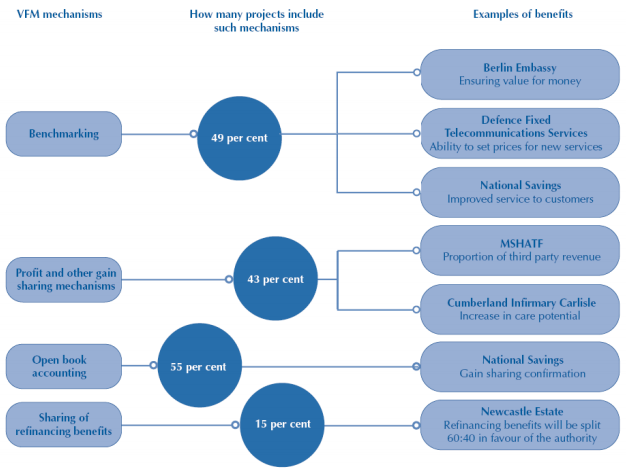
As seen from the UK experience the use of these instruments is not limited to infrastructure sectors or activities subject to formal statutory regulators. Reducing the asymmetry of information and securing an efficient supervision of the contract are key elements for ensuring that the expected benefits of PPPs materialize.
_____________________________________________________________
96 Laffont, J.J., "Translating principles into practice in regulation theory." CEER Working Paper, 1999.
97 Loeb and Magat (1979), "A Decentralized Method for Utility Regulation," Journal of Law and Economics, Vol. 22, pp. 399-404.
98 Baron and Myerson, 1982, "Regulating a Monopolist with Unknown Costs," Econometrica, Vol. 50, No. 4, pp. 911- 930.
99 NAO 2001 Managing