1.2.1 Reporting requirements for the construction stage (construction progress, commissioning and hand over reports)
Supervision during the construction stage can be divided into two main elements: economic and physical. Economic supervision relates to ensuring that any costs overruns by the private party are justified before they are documented in the contract. Physical supervision has to do with ensuring the assets are of the required quality and specification.
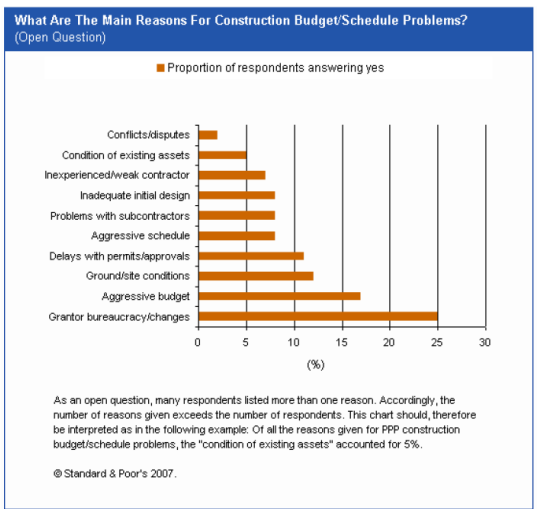
According to Standard & Poor's, multiyear construction works programs are often the most challenging stage in any PPP project's life cycle. They identify the "grantor bureaucracy and changes" as the main problem during this phase (see Chart 2)
Chart 2 - S&P Construction Problems
Source: Standard & Poor's 2007
According to this study, a quarter of the respondents identified the behavior of the public partner as the main issue in the construction phase. The actions or omissions of the public sector in this stage affect the PPP projects in different ways, as illustrated in the Box 16.
BOX 16 - Construction Problems
Capability. The client does not possess the experience, technical skills, or resources to manage the public-sector obligations associated with a long-term, active partnership with private-sector providers. Legacy. The client tries to manage PPPs as they have previously managed conventional design and build contracts, in an adversarial, "them-and-us" environment. Preparation. The client fails to define a clear output specification, to complete enabling works, to secure land, or to grant permits or approvals. Expectations. The public sector client's expectations of who is responsible for what, and what has to be delivered (by when) fail to match the private sector's understanding. Process. The client fails to establish streamlined, transparent procedures for day-to-day liaison with its private-sector partners. Oversight. Existing deficiencies in the client's project supervision and control procedures will not be cured, absent any other changes, simply by moving from traditional procurement methods to PPPs. Change. The client pushes for scope or specification changes, or variations, with limited regard for cost or time implications, or in the absence of contractual clarity about how such changes should be accommodated. |