Revenue
Irrespective of the specific form of PPP, payment mechanisms should be output based and devised in a manner such that the right incentives are created to achieve the desired results. Private-sector revenue is dependent on such mechanisms, and their monitoring (throughout the life of the PPP) will lead to contract equilibrium.
Revenue monitoring will ultimately also involve an analysis of the rate at which the operator will be compensated, particularly, its level and structure; however, certain considerations must also be made in connection with service demand risks.
The tariff rate systems, i.e. the set of criteria, rules and procedures used to define the tariff rate level and structure, and the regulatory mechanisms that govern subsequent reviews are, in the specific case of monopolistic public utilities, aimed at satisfying the sustainability, allocative efficiency, productive efficiency and quality requirements.
Sustainability as a goal entails that tariff must be sufficient to cover the economic costs of service provision. This also allows them to serve as a signal to achieve efficient consumption levels and attract new capital resources to the industry, so as to guarantee the future provision of the service while minimizing potential fiscal contributions.
Allocation efficiency is related, in a context of scarce resources and alternative uses for such resources, with tariffs reflecting the services' production costs, i.e. having tariffs equal marginal costs.123
Moreover, productive efficiency has to do with the minimization of costs at a given output level or, in the alternative, the maximization of output at a given level of supplies. For a long time now, both the regulatory literature and actual experience have demonstrated that the creation of incentives for companies to be productively efficient is one of the greatest challenges faced by regulators.124
Lastly, the tariff system must also provide for certain basic aspects of distributive efficiency or equity. This, in turn, is a two-fold aspect involving access and affordability. Access has to do with universal service goals: having the entire population have access. Affordability has to do with having tariffs relate to payment capacity, particularly for the poorer strata of the population.125
In addition to the substantive goals discussed above, tariff systems must also achieve certain formal goals in order to guarantee the best possible results for tariff regulations. Usually, such formal goals are: simplicity and public acceptance, no controversies, price stability, fair allocation of total costs, and no undue price discrimination.126
Insofar as the tariff regime is and is perceived as a simple, understandable and easily-applicable mechanism, its operation is not a constant cause for controversies, it brings stability to what users pay for the service they receive, it tends to fairly allocate the costs of service production and it does not unduly discriminate against certain customers, then it will not only be accepted by the public but also, and most importantly, it will help guarantee the sustainability of the scheme.
Payment to the operator may be a fixed lump sum, somehow distributed between the various service user categories. Payment may be effected directly to the operator or the government may act as a collecting agent or even pay the operator directly from treasury funds. In either case, the fixed-sum mechanism provides the operator with an incentive to bring down costs in order to take the efficiency gain for its own benefit. The risk lies with such cost reductions being made at the expense of service quality, which is the reason why certain minimum standards should be defined and monitored for compliance. Alternatively, the payment mechanism may be output based and carry some incentives system with it, in which case the operator's revenue will be dependent on the operator's performance.
Aligning service quality with customer rates in order to ensure that the output based payment mechanism works efficiently involves several steps. First it is necessary to evaluate objectives. More demanding quality standards may divert investment from other goals (expansion into non served areas). Secondly, the appropriate quality standards desirable for each service have to be defined. An optimal level of quality requires that marginal benefit (to the customer) and marginal cost (to the utility company) are equal. It is important to consider that optimal quality is given by costumer's willingness to pay and not by absolute standards. Finally it is necessary to establish an explicit link between quality and tariffs.
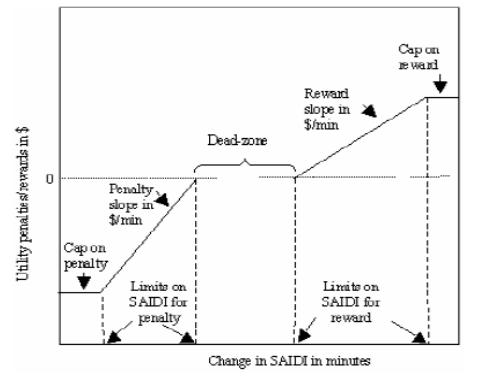
This link may take many forms including increases in revenues for above average performance or fines (revenue reductions) for below average performance. A combination of both can also me implemented (see Figure below for an example of the electricity sector linking tariff with interruption duration127).
Figure 1 : Output based Quality Incentives - Electricity
Whether payment is a fixed sum or a sum linked to operating performance, for payment to be released compliance with such standards and performance improvement needs to be verified.
However, it is also necessary to control that the agreed-upon sum allows service sustainability. Monitoring the payment level, which is nothing other than the public utility infrastructure tariff level, entails making sure that revenue is sufficiently high to cover the expected efficient levels for operating costs, depreciation and return on investment needs, the monitoring of which was discussed in the preceding section. Accordingly, if this is found to be the case, the contract remains in equilibrium. Put differently, revenue will only compensate for economically efficient expenses and investments that meet the contractual terms and conditions.
Clearly enough, at each tariff adjustment procedure the operators will demand higher rates. Therefore, to foster participation in, debate on and the transparency of decisions, tariff review processes usually take place through public hearings, so that the resulting tariffs are the result of some sort of agreement reached by all parties involved (the industry, users and the government).
Moreover, the specific tariff structure, meaning the manner in which the level of revenue to be collected is distributed among users, will not be a cause of serious concern for the operator, as the operator's interest will be focused on the tariff level, i.e. that the total revenue collected is sufficient. However, the structure will be of concern for service users. The discussion will revolve around the assessment of how much residential, industrial, rural, large users, etc. will pay. In this case, in making such decision, the regulator will be faced with the trade-off between equity and efficiency, of the known regulatory objectives.128 Having users represented at the public hearing processes will not only contribute to user claims being taken into consideration but also to having users actually understand the reasons behind the adjustments.
Lastly, demand-related considerations have to do with the risk entailed by fluctuations in demand. This risk will be higher or lower, depending on the specific regulatory system selected. In revenue-cap systems, where the operator is guaranteed a revenue cap, demand risk is clearly eliminated. Indeed, revenue is independent of the demand level; however, as explained above, this type of system, which similar to a fixed lump sum payment, creates greater risk in connection with service quality unless linked to minimum quality requirements.
Also it has to be noted that a pure revenue cap creates no incentive for the company to increase sales and could give way to perverse incentives in terms of the use of the infrastructure.
Price Cap systems entail greater demand risks, as what is set under such systems is a tariff cap that will be sufficient to cover the expected efficient operating expenses, depreciation and return on investment levels only if demand levels materialize as forecasted. Therefore, monitoring demand estimates becomes critical under these systems to avoid problems and maintain contract equilibrium.
____________________________________________________________________________________
123 In natural monopolies, this condition would breach the sustainability goal, as marginal costs are below average costs. See Sharkey (1982), The Theory of Natural Monopoly - Cambridge University Press.
124 Laffont and Tirole (1994) A Theory of Incentives in Procurement and Regulation.
125 See Estache Foster & Wodon for an analysis of the relationship between infrastructure reform and poverty in Latin America.
126 See Berg & Tshirhart (198?) for a discussion of these formal regulatory objectives.
127 The quality measure used is the SAIDI: System Average Interruption Duration Index. This index measures the time customers were without electricity in a given year. It is a measure of interruptions (in minutes) per customer. It includes planned and unplanned interruptions, but not momentary interruptions.
128 From an economic perspective, public services regulation seeks to secure four basic objectives: sustainability, allocative efficiency, productive efficiency, and equity. Estache and others (2002) contains a detailed discussion of regulatory objectives and instruments.