What is in the Reference Guide
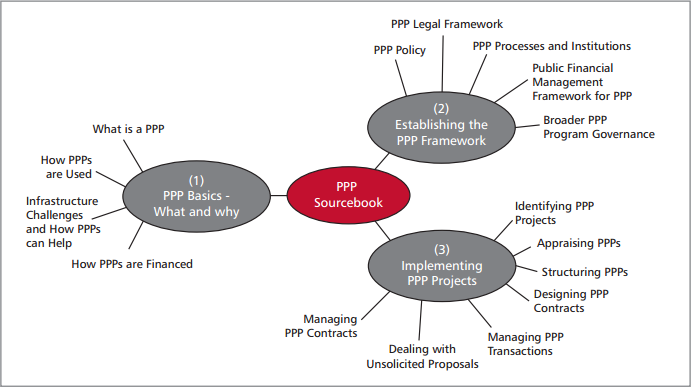
The Reference Guide is divided into the following three modules, addressing the questions above:
• Module 1: PPP Basics-What and Why? Provides an overview of Public-Private Partnerships (PPPs)-what they are, how they are used to provide infrastructure assets and services, their benefits, and their pitfalls
• Module 2: Establishing the PPP Framework. Describes the elements of a sound PPP framework- that is, the policy, processes, institutions, and rules that together define how PPPs will be implemented, and that promote good governance of a PPP program.
• Module 3: Implementing PPP Projects. Provides guidance on each stage of developing and implementing a PPP project-from initially identifying candidate projects, to managing PPP contracts through the project lifetime.
Each module begins with an introduction, providing an overall framework for the module's content, and listing any helpful overview references. The modules are divided into sections, each covering a different topic, as shown in Figure 1: PPP Reference Guide Overview.
Figure 1: PPP Reference Guide Overview
Each section provides a narrative describing the topic, and setting out the guiding principles and practical options that interested government officials should consider. This text is interspersed with references providing more information on key points on each topic. These references are highlighted in bold type, and followed, in square brackets, by a key reference number and page number, for example: [#1, pages 1-5]. This number refers the reader to a list at the end of the Guide, in which all references are presented- by clicking on the number the reader is sent to that listing; to return to the original page, the reader only needs to click Alt + Left Arrow key. The main references for each section are listed and briefly described at the end of the section.
Table 1: Key Reference Table-Example below provides an example from a "key references" table. In some cases, the reference tables are organized by subject area, within the overall topic. Readers who just want to quickly get a sense of the most important references on the topic can refer directly to these key references tables.
Table 1: Key Reference Table-Example
| Key References: PPP Processes and Institutional Responsibilities | |
| Reference | Description |
| Yescombe, E. R. (2013) Public-Private Partnerships: Principles of Policy and Finance, 2nd edition, Elsevier Science, Oxford | This book provides a comprehensive review of PPPs, including guidance to practitioners about key aspects of designing and implementing PPP policy and projects. Chapter 5 provides guidelines for public-sector appraisal of PPP projects |
| Farquharson, Torres de Mästle, and Yescombe, with Encinas (2011) How to Engage with the Private Sector in Public-Private Partnerships in Emerging Markets, World Bank/PPIAF | This guide for public sector practitioners describes how to develop and implement a PPP successfully, by developing a marketable project and attracting the right private partners. Chapter 4 describes guidelines for PPP project selection |
Where the text cites a document that is not considered a 'key reference', or uses a document as a source for a specific example presented in a Box, the full reference for the document is provided only in the Reference list. The Reference list includes all references reported in this Reference Guide-books, reports, articles, websites, and so on; with hyperlinks when available. Cross-references are also provided to content elsewhere within the Reference Guide, where the subject matters of Sections are linked.