PPP Contract Types
Throughout this Reference Guide, PPPs are described in terms of three broad parameters: first, the type of asset involved; secondly, what functions the private party is responsible for; and thirdly, how the private party is paid.
Many PPPs involve new assets-often called 'greenfield' projects. For example, the United Kingdom's PPP program-called the Private Finance Initiative (PFI)-involved private companies in financing, building, and managing new public assets, from schools and hospitals to defense facilities. PPPs can also be used to transfer responsibility for upgrading and managing existing assets to a private company-those are called 'brownfield' projects. In either case, a key feature of a PPP is that the assets or services provided are specified in terms of outputs rather than inputs-that is, defining what is required, rather than how it is to be done.
A central characteristic of a PPP contract is that it 'bundles' together multiple project phases or functions. Nonetheless, the functions for which the private party is responsible vary, and can depend on the type of asset and service involved. Typical functions can include the following:
• Design (also called 'engineering' work)-means developing the project from initial concept and output requirements to construction-ready design specifications
• Build, or Rehabilitate-when PPPs are used for new infrastructure assets, they typically require the private party to construct the asset and install all equipment. Where PPPs involve existing assets, the private party may be responsible for rehabilitating or extending the asset
• Finance-when a PPP includes building or rehabilitating the asset, the private party is typically also required to finance all or part of the necessary capital expenditure, as described further in Section 1.4: How PPPs Are Financed.
• Maintain-PPPs assign responsibility to the private party for maintaining an infrastructure asset to a specified standard over the life of the contract. This is typically considered a defining feature of PPP contracts
• Operate-the operating responsibilities of the private party to a PPP can vary widely, depending on the nature of the underlying asset and associated service. For example, the private party could be responsible for:
- Technical operation of an asset, and providing a bulk service to a government off-taker-for example, a bulk water treatment plant
- Technical operation of an asset, and providing services directly to users-for example, a PPP for a water distribution system
- Providing support services, with the government agency remaining responsible for delivering the public service to users-for example, a PPP for a school building that includes janitorial service.
The PPP payment mechanism is a third defining feature. The private party can be paid by collecting fees from service users, by the government, or by a combination of the two-with the common, defining characteristic that payment is contingent on performance. The options for a payment mechanism can depend on the functions of the private party:
• Under 'user pays' PPPs, such as toll roads, the private party provides a service to users, and generates revenue by charging users for that service. These fees (or tariffs, or tolls) can be supplemented by subsidies paid by government, which may be performance-based (for example, conditional on the availability of the service at a particular quality), or output-based (for example, payments per user)
• In 'government pays' PPPs, the government is the sole source of revenue for the private party. Government payments can depend on the asset or service being available at a contractually-defined quality ("availability" payments). They can also be output-based payments for services delivered to users-for example, a "shadow toll" road that is free for users, but for which the government pays a fee per driver to the operator.
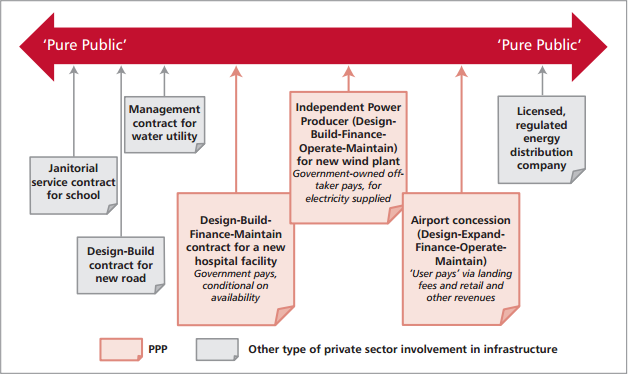
These characteristics can be combined in various ways, to create a wide range of PPP contracts. Figure 1: PPP Reference Guide Overview provides some examples. As Figure 1 illustrates, these contracts can be thought of as a continuum between public and private provision of infrastructure-transferring increasing responsibilities and risk to the private sector. PPPs are not the only way the private sector can be involved in infrastructure-Figure 1 also includes examples of arrangements that would not usually be considered as PPP. These 'adjacent' arrangements are described further below in Section 1.1.2: What PPP is Not: Other Types of Private Involvement.
Figure 1.1: Examples of PPP Contract Types