2.3.1 PPP Process
Many governments set out a process that must be followed to develop and implement every PPP project. Standardizing the PPP process helps ensure that all PPPs are developed in a way that is consistent with the government's objectives. It also helps achieve coordination between the various entities involved.
Figure 2.2: Typical PPP Process shows an example of a well-defined PPP process. The process is broken down into several stages, in which the PPP is iteratively developed and appraised. At each key stage, approval is required to proceed. There are two reasons to use an iterative approach to developing a PPP project. First, it enables timely involvement of oversight agencies in approving projects, as described further in Section 2.3.3. Second, it avoids wasting resources developing weak projects. Developing a PPP project is costly- early checks that the project is promising can help ensure development budgets are well-spent.
Figure 2.2: Typical PPP Process
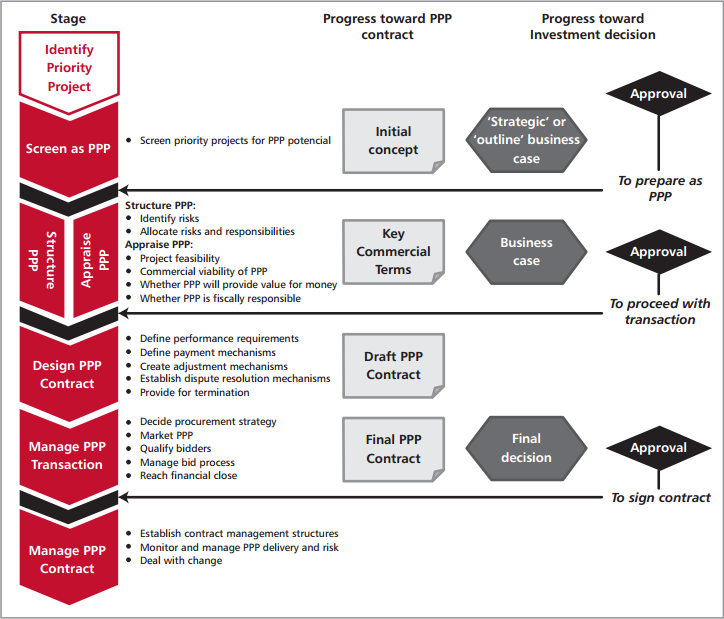
As shown in Figure, the process of developing and implementing a PPP is typically preceded by identifying a priority public investment project. A PPP is one way to deliver public investment-moreover, one that 'locks in' the specifications of the project over a long-term period. Potential PPP projects therefore typically emerge from a broader public investment planning and project selection process. At some point in this process some or all proposed public investment projects may be screened, to determine whether they may provide more value if implemented as a PPP.
Developing and implementing the PPP then involves several stages:
• Structuring and appraising the PPP-once a priority public investment project has been identified and initially approved for development as a PPP, the next step is typically to prepare the PPP structure, or 'key commercial terms'-including the proposed contract type, risk allocation, and payment mechanisms. This proposed PPP structure can then be appraised. Box 3.3: PPP Project Appraisal Criteria describes typical appraisal criteria and how these are assessed: value for money as a PPP, and affordability, as well as likely marketability as a PPP, in addition to the technical and economic viability of the underlying project (which may have already been assessed prior to identifying the project as a PPP, as described in Box 2.6). The proposed PPP structure and appraisal analysis is often pulled together in a 'business case' is often also developed, to demonstrate why the PPP is a good investment decision. Approval is typically needed at this stage, based on the analysis in the business case, before going on to prepare for and implement the PPP transaction
• Designing the PPP contract-the final step to prepare the PPP for procurement is to draft the PPP contract and other agreements. This involves developing the commercial principles into contractual terms, as well as setting out the provisions for change and how the contract will be managed, such as dispute resolution mechanisms. Often the design of the draft contract is completed in the early stages of the procurement process, to allow for consultation with potential bidders
• Implementing the PPP transaction-in the transaction stage, the government selects the private party that will implement the PPP. This usually involves preparing for and conducting a competitive procurement process. Bidders submit information detailing their qualifications and detailed technical and financial proposals, which are evaluated according to defined criteria-often in a multi-stage process-to select a preferred bidder. Since the bidding process typically also establishes some key parameters of the contract-in particular its cost-most processes involve a final approval at this stage. The transaction stage is complete when the project reaches financial close.
Once the PPP has reached financial close, the government must manage the PPP contract over its lifetime. This involves monitoring and enforcing the PPP contract requirements, and managing the relationship between the public and private partners.
An alternative to the government carrying out all these steps is to allow private companies to identify and propose PPP projects. Some governments have introduced specific requirements and processes to ensure that these unsolicited proposals are subject to the same assessment, and developed following the same principles, as government-originated PPPs. Section 3.6: Dealing with Unsolicited Proposals provides details and examples.
Module 3 of this Reference Guide describes the PPP process in detail, setting out options and providing information and guidance for practitioners on each stage. The following provide examples of how the PPP process is defined in a range of countries:
• In Chile, the Concessions law (2010) presents a thorough description of the PPP process including the preliminary proposal by the contracting agency, the tender process [#46, Chapters II and III, Articles 2-14]
• In Egypt, the Ministry of Finance has published a step-by-step guide to developing PPPs (undated- accessed 2011) [#68]. The guide directs the relevant Ministries through the PPP process, from identifying a project through developing a business case and the procurement process
• An ADB publication on PPP projects in Korea (2011) [#171, pages 61-72] includes a detailed description of the PPP implementation process for different types of PPP, including unsolicited projects
• The PPP Guidelines of the Government of Malaysia (2005) [#179, page 11] provides an overview of its PPP process
• In Mexico, the PPP Law (2012) describes all the studies that must be carried out to assess the viability of a PPP project; sets out the PPP approval process; sets out the activities and institutional responsibilities in running a PPP tender process; and describes the bid evaluation process and the selection of the winning bid [#185, articles 14, 21-25, 38-51, and 52-59]
• Peru's Legislative Decree No.1012 (2008) lays out the process for carrying out a PPP, establishes the criteria for selecting projects and the PPP modality, and defines the steps and responsibilities in project design and approval [#199, Title III, Articles 7-9]
• The Implementing Rules and Regulations of the Philippines BOT Law set the PPP process in the Philippines [#203, pages 11-51 and Annexes]
• In Puerto Rico, the PPP Act (2009) [#210, sections 7-10], presents a detailed description of the PPP process including conducting initial desirability and convenience analysis, setting up a Partnership Committee to implement the tender process and the PPP contract, and selecting proponents and awarding partnerships
• The South Africa PPP Manual (2004) [#219] has an introduction that provides a brief overview of the PPP process. The process is explained in detail in the manual, with a module dedicated to each step
• Spain's Public Procurement Law (2011) [#223] has a detailed description of the PPP process, including the project appraisal requirements, disclosure requirements at each stage, the approval process, and tendering options.