3.4 Designing PPP Contracts
The PPP Contract is at the center of the partnership, defining the relationship between the parties, their respective rights and responsibilities, allocating risk, and providing mechanisms for dealing with change. In practice, the 'PPP Contract' can encompass several documents and agreements, as described in Box 3.9: What is the 'PPP Contract''.
| Box 3.9: What is the 'PPP Contract' This section uses the 'PPP contract' to mean the contractual documents that govern the relationship between the public and private parties to a PPP. In practice, the 'PPP contract' may comprise more than one document. For example, a PPP to design, build, finance, operate, and maintain a new power plant, with power supplied in bulk to a government-owned transmission company, may be governed by a Power Purchase Agreement (PPA) between the transmission company and the PPP company, as well as an Implementation Agreement between the responsible government ministry and the PPP company. Each agreement may in turn refer to schedules or annexes to set out particular details-for example, detailed performance requirements and measures. In addition to the PPP contract, there will also be numerous contracts between the private parties to the PPP. Chief among them would be contracts between the project company and its EPC contractor, financing agreements between the project company and its lenders, and shareholders agreements between equity investors. (See Section 1.4: How PPPs Are Financed for more on the PPP contractual structure). The PPP contract may not be effective until these other contractual agreements are in place. The EPEC Guide to Guidance [#83, page 23] lists topics that should be covered in a typical PPP contract-the standardized contracts below provide further examples. The PPIAF Toolkit for PPP in Highways [#282] section on contracts describes the range of contractual agreements typically involved for different types of PPP. |
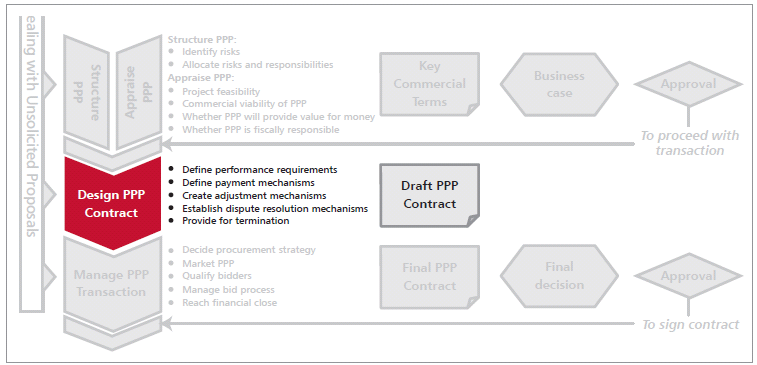
As shown in Figure 3.5: PPP Contract Design Stage, the draft PPP contract is generally needed before a Request for Proposals (RFP) is issued. Detailed contract design takes significant time and resources-including from expert advisors. Approval is often required before embarking on detailed design and investing these resources.
The draft PPP contract is typically included with the Request for Proposals (RFP) sent to prospective bidders. In some cases, the PPP contract issued with the RFP cannot be changed. In others, it may be changed as a result of interaction with bidders during the transaction process. Australia National PPP Guidelines Roadmap [#16] provides an overview of PPP contract development and how it progresses at each stage of implementing the PPP.
Figure 3.5: PPP Contract Design Stage
Aim of PPP contract design
A well-designed contract is clear, comprehensive, and creates certainty for the contracting parties. Because PPPs are long-term, risky, and complex, PPP contracts are necessarily incomplete-that is, they cannot fully specify what is to be done in all future states of the world. This means the PPP contract needs to have flexibility built in, to enable changing circumstances to be dealt with as far as possible within the contract, rather than resulting in re-negotiation or termination.
The aim of PPP contract design is therefore to create certainty where possible, and bounded flexibility where needed-thereby retaining clarity and limiting uncertainty for both parties. This is typically done by creating a clear process and boundaries for change. To implement this style of contract in practice requires strong contract management institutions, as described in Section 3.7: Managing PPP Contracts. Where possible, involving the future contract manager in designing or reviewing the PPP contract can help ensure that change management processes are implementable in practice.
Content of this section
PPP contract design is a complex task. This section briefly sets out some key considerations-and provides links to tools, examples, and further resources-in five areas of PPP contract design:
• Performance requirements-defining the required quality and quantity of assets and services, along with monitoring and enforcement mechanisms, including penalties
• Payment mechanisms-defining how the private party will be paid, through user charges, government payments based on usage or availability, or a combination, and how bonuses and penalties can be built in
• Adjustment mechanisms-building in to the contract mechanisms for handling changes, such as extraordinary reviews of tariffs, or changing service requirements
• Dispute resolution procedures-defining institutional mechanisms for how contractual disputes will be resolved, such as the role of the regulator and courts, or the use of expert panels or international arbitration
• Termination provisions-defining the contract term, handover provisions, and circumstances and implications of early termination.
Together, these sets of provisions define the risk allocation under the contract. Obviously the aim must be to draft these provisions so that the risk allocation chosen (as set out in Section 3.3: Structuring PPP Projects) is achieved. The provisions dealing with adjustment mechanisms and dispute resolution are intended to avoid the need for renegotiation, by allowing changes to be made, and problems resolved, within the framework provided by the contract.
Many countries standardize elements of PPP contract design. This helps reduce the cost of developing the contract for each PPP contract. Some develop model contracts or contract clauses-Table 3.1: Examples of Standardized PPP Contracts and Contract Clauses provides some examples. Others incorporate some elements in overall legislation to govern all PPP contracts, as described in 2.2: PPP Legal Framework. For example, in Chile the dispute resolution mechanism is established in the Concessions Law.
A helpful complement to the guidance in this section is the World Bank's online PPP Infrastructure Resource Center, at the following link: http://ppp.worldbank.org/public-private-partnership/content/agreements [#285]. This website hosts a collection of actual PPP contracts and sample agreements for a range of contract types and sectors.
Table 3.1: Examples of Standardized PPP Contracts and Contract Clauses
| Jurisdiction | Standard | Links |
| Australia | Guidelines issued by Infrastructure Australia provide standard commercial principles for social and economic infrastructure PPPs respectively, set out why and how key risks and responsibilities should be allocated in the contract | Australia, Infrastructure Australia (2008) National PPP Guidelines: Commercial Principles for Social Infrastructure (Vol. 3), Canberra: http://www.infrastructureaustralia.gov.au/public_private/files/National_PPP_Guidelines_Vol_3_Commercial_Principles_Social_Infrastructure_Dec_08.pdf Australia, Infrastructure Australia (2011) National PPP Guidelines: Commercial Principles for Economic Infrastructure (Vol. 7), Canberra: http://www.infrastructureaustralia.gov.au/public_private/files/Vol_7_Commercial_Principles_Economic_Infrastructure_Feb_2011.pdf |
| India | Descriptions of model agreements for PPP in a range of transport sectors | India, Secretariat for Infrastructure (2011) Model Concession Agreement. New Delhi: http://infrastructure.gov.in/mca.htm |
| Netherlands | Standard PPP contract for DBFM in buildings and DBFMO in infrastructure | Netherlands, Ministry of Finance.(n.d.) Publications. The Hague http://www.ppsbijhetrijk.nl/Publicaties?publicatiesoort=Modeldocument (Dutch and English versions) |
| New Zealand | Draft standard PPP contract | New Zealand, National Infrastructure Unit (2010) Draft Public Private Partnership (PPP) Standard Contract - Version 2. Wellington: http://www.infrastructure.govt.nz/publications/draftpppstandardcontract |
| Pakistan | Standardized PPP Provisions | Pakistan, Infrastructure Project Development Facility (2007) Standardised PPP Provisions. Islamabad: http://www.ipdf.gov.pk/ tmpnew/PDF/PPP%20Contractual%20Standardized%20Provisions.pdf |
| Philippines | Sample contracts for PPP in bulk water supply, ICT, solid waste management, and urban mass transit. The PPP Center is currently developing standardized terms for broader application | Philippines, Public-Private Partnership Center (2011) PEGR Sample Contracts. Manila: http://ppp.gov.ph/?page_id=671 |
| South Africa | Standardized PPP provisions published alongside the South Africa PPP Manual | South Africa, National Treasury (2004) Standardised PPP Provisions, Johannesburg: http://intellect-ht.com/images/downloads/docs/12.pdf |
| United Kingdom | Standardized contracts for PFI projects, includes extensive guidance on each element of the contract | United Kingdom, Her Majesty's Treasury Standardised contracts, London: http://www.hm-treasury.gov.uk/ppp_standardised_contracts.htm |