3.5 Managing PPP Transactions
In the transaction stage, the government selects the private party that will implement the PPP. This stage follows the structuring, appraisal, and detailed preparation of the PPP described in the previous sections of this Module. It concludes when the PPP reaches financial close-that is, when the government has selected and signed a contract with a private party, and the private party has secured the necessary financing and can start deploying it in the project.
Figure 3.6: Transaction Stage of PPP Process
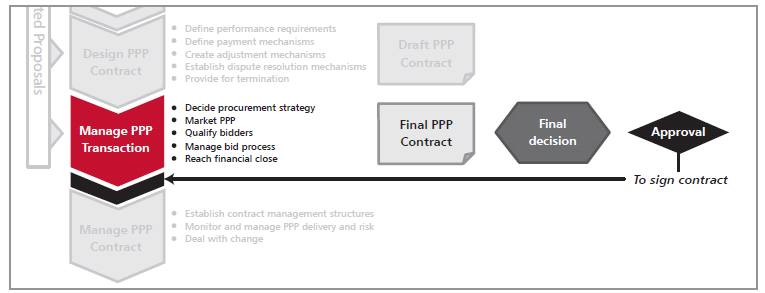
The aim of the PPP transaction stage is twofold. The first is to select a competent firm or consortium. The second is to identify the most effective and efficient solution to the proposed project's objectives-both from a technical, and value for money perspective. To the latter end the process typically establishes some of the key quantitative parameters of the contract: the amounts government will pay, or the fees users will pay for the assets and services provided. Achieving these objectives generally requires a competitive, efficient, and transparent procurement process, as set out for example in the PPIAF Toolkit for PPPs in Roads and Highways Procurement section [#282] under 'competitive bidding', and by Farquharson et al [#95, page 112] in describing the outcome of the procurement phase.
Since most governments use a competitive selection process to procure PPP contracts, as the best way to achieve transparency and value for money, this section assumes a competitive process is followed. In practice, there may be a few circumstances where direct negotiation could be a good option. However, many reasons put forward to negotiate directly are spurious, as described in Box 3.11: Competitive Procurement or Direct Negotiation.
Box 3.11: Competitive Procurement or Direct Negotiation A competitive selection process is typically recommended to procure PPP contracts. Key advantages are transparency, and use of competition to choose the best proposal-the mechanism most likely to result in value for money. The alternative to a competitive process is to negotiate directly with a private firm. There can be good reasons to negotiate directly, but these are relatively few-see for example Kerf et al's guide to concessions [#169, pages 109-110] or World Bank water sector PPP toolkit [#273, page 170] sections on direct negotiation. These good reasons can include: • Small projects, where the costs of a competitive process would be prohibitively high given the level of expected returns • Cases where there is good reason to believe there would be no competitive interest-for example, extensions of an asset for which a contract is already in place • Need for rapid procurement in the case of emergencies and natural disasters, where speed may outweigh value for money considerations On the other hand, several reasons commonly put forward to negotiate directly with a private proponent of a PPP can be misleading-see for example PPIAF's toolkit for PPPs in Roads and Highways [#282] Module 5 Procurement section on 'overall principles for procurement'. For example, some argue negotiation is faster-although ultimately, challenges in and to the process can often mean it ends up taking longer. Direct negotiation is also often considered when a PPP idea has originated as an unsolicited proposal from a private company-but there are also ways to introduce competition in this case that help ensure value for money from the resulting project, described in Section 3.5: Managing PPP Transactions. Based on these considerations, some countries do not allow non-competitive procurement processes at all (such as Brazil, under the Federal PPP Law of 2004 [#34]). Elsewhere, direct negotiation may be allowed in particular circumstances. For example, Puerto Rico's PPP Act also allows for direct negotiations if investment value is under US$5 million, there is lack of interest after issuing an RFP, the normal procurement process is burdensome, unreasonable, or impractical, or the technology required is only available from a single company [#210, Article 9.(b).ii] |
Figure 3.7: Transaction Steps
|

The transaction stage typically includes the following five steps, as shown in Figure 3.7: Transaction Steps:
• Deciding on a procurement strategy, including the process and criteria for selecting the PPP contractor
• Marketing the upcoming PPP project, to interest prospective bidders (as well as potential lenders and sub-contractors)
• Identifying qualified bidders through a qualification process. This may be done as a separate step before requesting proposals, or may be part of the bidding process
• Managing the bid process, including preparing and issuing a Request for Proposal, interacting with bidders as they prepare proposals, and evaluating bids received to select a preferred bidder
• Executing the PPP contract and ensuring all conditions are met to reach contract effectiveness and financial close. This may require gaining final approval of the contract from government oversight agencies.
Sections 3.5.1: Deciding the Procurement Strategy to 3.5.5: Achieving Contract Effectiveness and Financial Close describe each of these steps, and provide further resources and tools for practitioners interested in managing PPP transactions.