3.6.4 Defining Clear Processes
Clear processes for handling unsolicited proposals are important for transparency, helping build confidence among all stakeholders that projects developed from unsolicited proposals deliver value for money. Clear processes can also help incentivize private developers to invest resources in developing good-quality project proposals, and encourage potential competitors to engage in the bidding process.
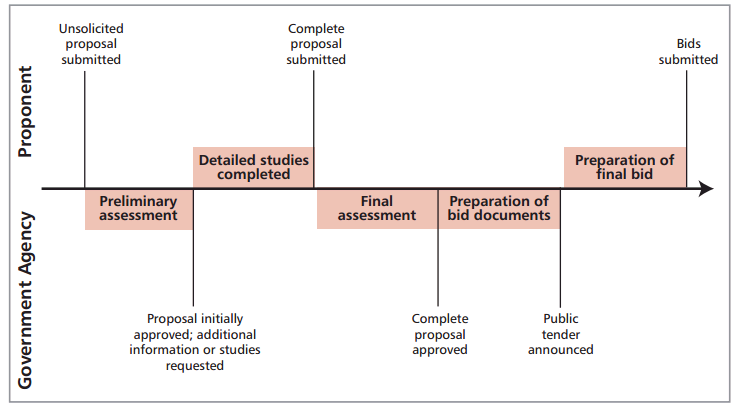
Hodges and Dellacha [#129] describe a well-defined process to assess, approve and bid out a project from an unsolicited proposal, as illustrated Figure 3.8: Process for Assessing, Approving and Bidding an Unsolicited Proposal. First, a private company submits an unsolicited proposal, following clear content and presentation requirements. This proposal is screened, often following a similar approach as described in Section 3.1.2: Screening for PPP Potential. If the proposal passes the initial screening, the proponent is invited to complete any necessary studies before the proposal is assessed against the same criteria as any PPP (as described in Section 3.2: Appraising PPP Projects). If approved, any developers' fee or bonus that will apply is often agreed at this stage.
The responsible government agency then prepares bid documents, based on the final proposal, and conducts a tender process. Proponents may or may not have an opportunity to respond to the bid documents and submit a final bid. For example, in Korea the proponent may modify its original proposal and bid, but in doing so forfeits some of its bid bonus (as described in an ADB/KDI report on PPP experience in Korea [#171, pages 67-69]).
Figure 3.8: Process for Assessing, Approving and Bidding an Unsolicited Proposal
Source: Based on Hodges and Dellacha [#129, page 7]
Many countries specify time periods within which each of these steps will be taken. Hodges and Dellacha [#129, pages 12-13] describe the benefits and risks of doing so. On the one hand, specific deadlines within which the government will deal with proposals can be helpful to provide assurance to the private sector that their proposal will not languish in the process.
On the other hand, some countries introduce tight limits on the time allowed for competing proposals, which could deter competition. For example, in the Philippines, the BOT Law of 1993 [#202] requires authorities to advertise an opportunity for three weeks, and allow 60 days for competitors to respond-which is unlikely to allow competitors to carry out the due diligence necessary to prepare a high-quality proposal.
Table 3.5: Examples of Procurement Strategies for Unsolicited Proposals briefly describes processes for dealing with unsolicited proposals in several countries. Chile's concessions law [#46], in particular, sets out the approach and requirements in detail. The ADB/KDI report on PPP experience in Korea [#171, pages 67-69] also describes each step in the procedure for dealing with unsolicited proposals.
| Key References: Dealing with Unsolicited Proposals | |
| Refer ence | Description |
| World Bank (2009) Online Toolkit for Public Private Partnerships in Roads and Highways | Module 5: Implementation and Monitoring, Stage 3: Procurement includes a section on unsolicited proposals, which describes their benefits and challenges, and provides examples of both successful and unsuccessful PPPs from unsolicited proposals |
| World Bank (2011) PPP in Infrastructure Resource Center, http://ppp.worldbank.org/public-private-partnership/ | Section on "procurement processes and standardized bidding documents" briefly describes the World Bank's view on unsolicited proposals, and provides examples from and links to some countries' relevant law and policies |
| Reddy & Kalyanapu, Unsolicited Proposal: New Path to Public-Private Partnership, Indian Perspective, Netherlands: Eindhoven University of Technology | Describes the approach to dealing with unsolicited proposals in several Indian states, which have adopted a Swiss Challenge process, and draws lessons from India's experience |
| Hodges & Dellacha (2007) Unsolicited Infrastructure Proposals: How Some Countries Introduce Competition and Transparency, PPIAF Working Paper No. 1, World Bank | Describes commonly-used rationales for advocating direct negotiation on the basis of unsolicited proposals, and describes the systems and policies that some countries have instead introduced to promote competitive tension. Appendices describes the approach and experience with unsolicited proposals in several countries in Asia, Africa, and the Americas, and includes links to the relevant laws and regulations |
| United Nations (2001) Legislative Guide on Privately Financed Infrastructure Projects, New York, United Nations Commission on International Trade Law | Section E provides guidance on both policies and procedures for dealing with unsolicited proposals. Distinguishes between proposals that do or do not require proprietary technology |
| Hodges, J. (2003) Unsolicited Proposals: The Issues for Private Infrastructure Projects, Public Policy for the Private Sector, Note Number 257 | Provides an overview of important issues governments face when dealing with unsolicited proposals-when and how they should be accepted, and why and how competition should be introduced into the process |
| Hodges, J. (2003) Unsolicited Proposals: Competitive Solutions for Private Infrastructure Projects. Public Policy for the Private Sector, Note Number 258 | Describes the experience of four countries in dealing with unsolicited proposals: Chile, the Republic of Korea, the Philippines, and South Africa |
| Examples: Dealing with Unsolicited Proposals | |
| South Africa, National Roads Authority (1999) Policy of the South African National Roads Agency in Respect of Unsolicited Proposals, Johannesburg | Describes the policy and sets out the procedure for dealing with unsolicited proposals for national roads PPPs. Includes a description of the required content of the proposal, the process for detailed preparation of the PPP and tender documents, and the tender process that will apply |
| Indonesia (2005) Peraturan Presiden Republik Indonesia Nomor 67 Tahun 2005, as amended by (2011) Peraturan Presiden Republik Indonesia Nomor 56 Tahun 2011, Jakarta | Chapter IV states that unsolicited proposals will be accepted for projects not already on a priority list, and briefly outlines the process and procurement approach. (The English version of regulation 56 is available on Bappenas' website.) |
| Chile, Ministerio de Obras Públicas (2010) Ley y Reglamento de Concesiones de Obras Públicas, Santiago | Title II of Regulation Number 956 of the Public Works Concessions describes in detail the process and for dealing with unsolicited proposals, including the required content of initial proposals, how detailed studies will be managed, how proposals will be evaluated, and procured |
| Articles 153-155 describe when unsolicited proposals are accepted, how they are evaluated, and the procurement process that applies | |
| Kim, Jay-Hyung, Jungwook Kim, Sung Hwan Shin & Seung-yeon Lee (2011) PPP Infrastructure Projects: Case Studies from the Republic of Korea (Vol. 1), Manila, Philippines: Asian Development Bank | Pages 61-69 describe the implementation procedures for PPP projects, including those originated as unsolicited proposals |
| Philippines Build-Operate-Transfer Center (1993) Republic Act No. 7718 (The Philippines BOT Law) and its Implementing Rules & Regulations, Makati, Philippines | Rule 10 states that unsolicited proposals will be accepted for projects not already on a priority list, sets out how proposals should be evaluated, how competing bids will be invited (under a Swiss Challenge process), and how the government may negotiate with the proponent in the absence of competing bids |
| United States, The Commonwealth of Virginia (2005) Public-Private Transportation Act of 1995 (as Amended): Implementation Guidelines, Richmond, VA | Sets out the process for developing and implementing PPPs, both from solicited and unsolicited proposals. Includes detailed guidance on the required content of unsolicited proposals |
| Uruguay, Asamblea General (2011) Ley N° 18786, Montevideo | Article 37 discusses the advantages granted to the proponent submitting an unsolicited proposal. |
| Australia, New South Wales Treasury (n.d.) Intellectual Property Guideline for Unsolicited Private Sector Proposals Submitted Under Working With Government, Sydney, available online at www.wwg.nsw.gov.au/ | Provides a checklist of intellectual property issues that should be covered in unsolicited proposals, intended as guidance for proponents |
| Australia, Partnerships Victoria (2001) Practitioners' Guide, Melbourne | Section 21: Unsolicited Proposals sets out how intellectual property in unsolicited proposals will be dealt with |