3.7 Managing PPP Contracts
Managing PPP contracts involves monitoring and enforcing the PPP contract requirements, and managing the relationship between the public and private partners. The contract management stage spans the lifetime of the PPP agreement, from the date of contract effectiveness to the end of the contract period.
Figure 3.9: Contract Management Stage of PPP Process
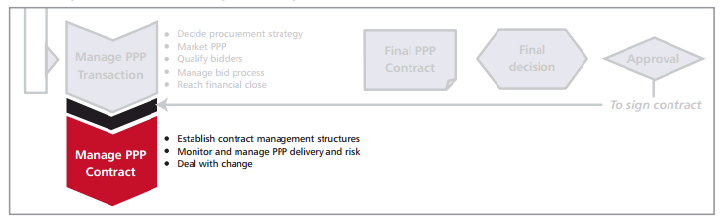
Managing PPP contracts differs from managing traditional government contracts. PPPs are long-term and complex, and contracts are necessarily incomplete-that is, the requirements and rules in all scenarios cannot be specified in the contract. The aims of contract management for PPPs are to ensure:
• Services are delivered continuously and to a high standard, in accordance with the contract, and payments or penalties are made accordingly
• Contractual responsibilities and risk allocations are maintained in practice, and the government's responsibilities and risks managed efficiently
• Changes in the external environment-both risks and opportunities-are spotted and acted on effectively.
These aims of contract management are elaborated in the 4Ps Guide to Contract Management for PFI and PPP Contracts in the United Kingdom [#229, page 5]. The South Africa PPP Manual section on PPP Agreement Management [#219, Module 6, pages 11-12] describes what is needed and what is meant by successful management of a PPP contract, as well as what can go wrong in contract management, and why. EPEC's 2014 Guidance for Managing PPPs [#89] condensates European experiences on the topic.
The foundations for effective contract management are laid earlier in the PPP implementation process. Many aspects of contract management-such as procedures for dealing with change, and dispute resolution mechanisms-are set out in the PPP agreements, as described in Section 3.4: Designing PPP Contracts.
This section describes four key aspects of putting contract management into practice for PPP projects:
• Establishing contract management institutions-defining and establishing the responsibilities and communication mechanisms that will enable an effective relationship between the public and private partners to the contract
• Monitoring PPP delivery and risk-monitoring and enforcing contract compliance and service performance by the private party, ensuring the government delivers on its responsibilities under the contract efficiently, and monitoring and mitigating risk
• Dealing with change-putting into practice the mechanisms described in Section 3.4: Designing PPP Contracts to deal with contract adjustments, dispute resolution, and contract termination, as well as deciding whether, when and how to re-negotiate
• Managing contract expiry and asset handover-managing the transition of assets and operations at the end of the contract term.
The United Kingdom Treasury's Operational Taskforce, part of the PPP Unit, has produced comprehensive guidance notes covering several topics on contract management for PPPs [#232].