Section 1 Introduction
Twenty years from now you will be more disappointed by the things that you didn't do than by the ones you did do, so throw off the bowlines, sail away from safe harbor, catch the trade winds in your sails. Explore, Dream, Discover.
-Mark Twain
Public private partnerships (PPP) represent an approach to procuring infrastructure services that is radically different from traditional public procurement. It moves beyond the client-supplier relationship when Government hires private companies to supply assets or a service. PPP is a partnership between public and private to achieve a solution, to deliver an infrastructure service over the long term. It combines the strength of the public sector's mandate to deliver services and its role as regulator and coordinator of public functions with the private sector's focus on profitability and therefore commercial efficiency.
"PPP" is used here in its most inclusive form, to mean any contractual or legal relationship between public and private entities aimed at improving and/or expanding infrastructure services. Clearly, the more extensive the private involvement, the more supportive the investment climate needs to be. The term "Government" will be used to mean the level of Government responsible for the reform processes, whether it be the federal, state or municipal Government. The two counterparties to the main project contract will be referred to as the "contracting agency" on the public side and the "project company" on the private side. PPP can be implemented as a series of ad hoc projects or as a program of projects coordinated and enabled centrally. This text discusses the latter-"PPP programs".
One of the challenges for Governments wanting to implement a conducive PPP framework is the variety of models and approaches put forward by different countries, advisers and commentators. A common approach is to try to adopt the fully functioning framework used by a country that has been very successful in developing a PPP program, in one fell swoop. This involves taking, for example, the PPP program in England and Wales and replicating it wholesale for any given country. But, these "best practice" PPP programs have developed over many years, through numerous challenges and frustrations and for a specific legal, political and financial context. When adopting the processes and procedures of one of these countries wholesale into a jurisdiction with little experience in PPP, the tendency is to expect the PPP program to be equally successful in a short timeframe, as if a robust PPP framework will immediately result in robust PPP projects. Clearly, this is not accurate.
This text suggests that development of a conducive framework for PPP involves a dynamic, iterative process supported by different functions and actors within the Government, the private sector and the communities in question. Transparent, competitive selection of the private partner is fundamental to provide a level playing field, foreseeable processes and best price, terms and conditions for the Government. Instead of proposing a single model, this text discusses the different elements that together make up an effective PPP framework.
Figure 1.1: The Context of a Conducive PPP Framework |
|
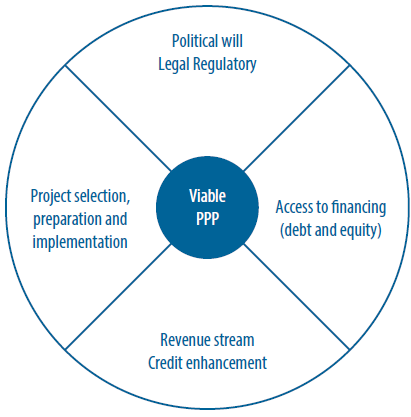
Figure 1.1 identifies what it takes to achieve a good, sustainable PPP framework:
• the political will to pursue PPP, and the legal and regulatory regime appropriate to enable and encourage PPP
• selection, design and development of "good" projects-the most appropriate and feasible projects for PPP
• allocating risk to the private sector while insulating investors from those risks best borne by the contracting agency or the Government
• ensuring that the financial markets are in a position (legally, financially and practically) to provide the project with the investment it needs (debt, equity and otherwise), including by providing Government support.
Generally, simpler is better. As a PPP program matures, the PPP framework may become more complex. But in the early days, it is generally better to keep the framework simple. Different constituencies will need to understand the framework - contracting agencies, line ministries, central ministries, investors, and the public at large. Simple mechanisms will help these key stakeholders understand and interact with the PPP framework more easily.
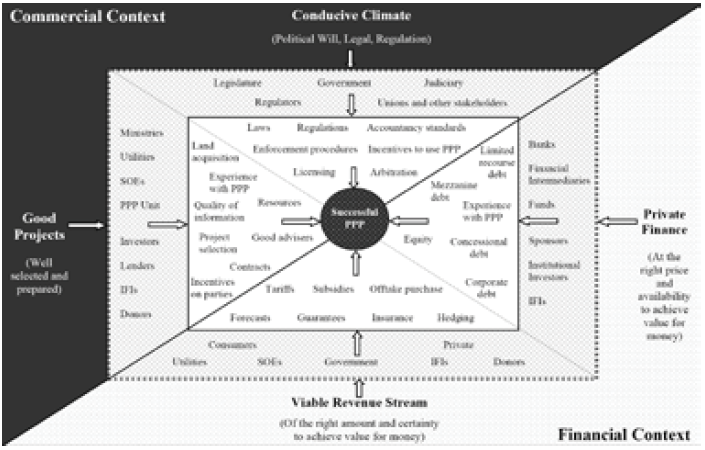
Figure 1.2 shows a more detailed depiction of the diversity of reforms and instruments that together can support a good, sustainable PPP program. The outer square shows the macro issues. The middle square identifies the key participants in achieving each of the macro-drivers.
The inner square shows the tools available to those participants. One worth highlighting is "experience with PPP". It is important for the contracting agency, investors and lenders to have access to individuals experienced with PPPs, to help them understand the risk profile, terms and conditions, market standards and financing arrangements typical of such projects.
A gap analysis identifies areas in the PPP framework that can be improved.
The main activities to be addressed in this strategic plan for PPP framework reform will include:
• establish policy
• draft and pass necessary laws and regulations
• create, staff and coordinate institutions, committees and task forces
• create operating guidelines and best practice guidance to establish transparent, competitive processes
• select and develop a pipeline of good projects, including strategic demonstration projects
• establish processes, practices and funding for Government support, including project preparation and fiscal risk management
• implement program monitoring, knowledge capture, and sharing of lessons learned.
Figure 1.2: PPP Investment Climate |
|
An action plan for PPP framework reform will focus on practical actions associated with these topics. There is a tendency to approach reform of the PPP framework as a single action, generally delivered by external consultants in one massive report, with a few workshops and training sessions (in an effort to deliver the guidance in a more digestible form). But such interventions are rarely effective.
On the contrary, achieving a viable PPP framework involves a complex series of parallel, iterative initiatives and efforts. It involves updating the different elements of the PPP framework discussed in this text as each new lesson is learned from PPP transactions as they are implemented and national best practice as it develops.
Section 1 introduces the framework required to support PPP and provides a summary of the text. Sections 2-6 then describe five key elements of the PPP framework and what the Government can do to improve them:
• The legal framework-how laws and regulatory structures can be used to encourage PPP, support the institutions implementing PPP and regulate them (section 2)
• The institutional framework-the people involved, the decision making power they have and the functions they perform (section 3)
• The project procurement process and Government involvement in each phase thereof (section 4)
• Using Government funding to support project viability, maximize competition, reduce financial risk and keep project costs low (section 5)
• Mobilizing long-term local currency financing for PPP projects, for example by using a financial intermediary (section 6).
| Key Messages for Policy Makers |
| • Learning by doing-an important part of identifying gaps in the investment climate is learned while "doing", while implementing PPP projects. • Use small steps without being timid-start with easier projects that are clearly financially viable and have political support. But these projects need to provide a signalling effect; they need to be sufficiently substantial and strategic to ensure Government buy-in, the interests of private investors and a statement to the market that the framework for PPP in the country is conducive. • Learn from the experiences of others, without being dogmatic-there is a tendency to try to replicate the successes of other countries. While it is important to learn from the successes and failures of others, it is generally unwise to try to replicate an entire framework, wholesale. • Keep it simple-complex is not necessarily comprehensive or better, the PPP framework needs to be understood by a wide group of stakeholders. |
This text is adapted from Jeffrey Delmon, Public Private Partnership Programs: A framework for private sector investment in infrastructure (Kluwer International 2014).1 Key messages for policy makers are provided throughout the text, with a full list of these set out in an annex.
_________________________________________________________________________________________________
1 For further discussion of the development and financing of PPP, see Delmon, Public Private Partnership Projects in Infrastructure: An essential guide for policy makers (Cambridge University Press 2011); and Delmon, Private Sector Investment in Infrastructure: Project finance, PPP projects and risk (Kluwer International 2ed, 2009).