4.2 VIABILITY/FEASIBILITY STUDY/FULL BUSINESS CASE
The decision on implementation of a project through PPP will follow a "viability" or "feasibility" study (also known as a "full business case"), which is a more detailed version of the pre-feasibility study. The contracting agency performs a feasibility study to commence project structuring and key risk allocation decision making. It is at this stage that the fundamental design of the PPP solution is defined.
Figure 4.1: The PPP Project Cycle |
Source: Republic of South Africa website. |
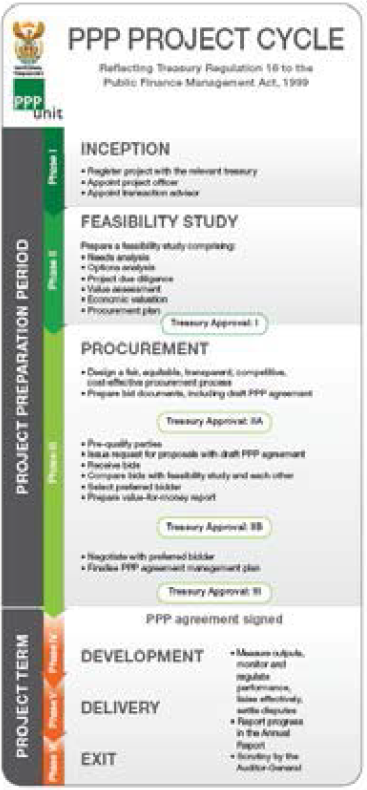
Failure to implement the different stages of project preparation properly, with sufficient time, funding and expert advice has doomed many a PPP project and program; this preparation process should not be curtailed. As in most such exercises, a balance needs to be found between the time and expense of the "perfect" feasibility study, and a feasibility study that addresses enough to meet market, contracting agency and Government approval requirements.
| Box 4.1: Optimism Bias or Bad Incentives-How Planning Goes Wrong |
| Planning and forecasting need to reflect benefit to the Government, through cost-benefit or value for money assessments. But such assessments tend to involve incentives for those performing them to emphasize benefits and de-emphasize costs, whether consciously or not.a There is a similar bias towards new build, rather than refurbishing what exists and maintaining it properly. Maintaining a road properly is more than three times less expensive than maintaining it poorly and rebuilding later. But the socio-political incentive is to build something big and new that can carry the name or be identified with a politician or political party. Khan and Levinson (2011) highlight the failure in the US national highway system to maintain roads properly due in part to the tendency for federal monies to be allocated to new build projects rather than maintenance or refurbishment.b The Private Infrastructure Investment Management Center in South Korea routinely rejects 46% of proposed projects (compared with 3% before its creation) at a savings of 35% to the Government on poorly planned or selected projects. Similarly, Chile's national Public Investment System rejects 25-35% of projects proposed.c Source: McKinsey Global institute, "Infrastructure productivity: How to save $1 trillion a year" (January 2013). a See Flyvbjerg, "Survival of the unfittest: Why the worst infrastructure gets built-and what we can do about it," Oxford Review of Economic Policy, volume 25, number 3, 2009; McKinsey Global institute, "Infrastructure productivity: How to save $1 trillion a year" (January 2013). b Kahn and Levinson, "Fix it first, expand it second, reward it third: A strategy for America's highways," The Hamilton Project discussion paper 2011-2013 (February 2011); McKinsey Global institute, "Infrastructure productivity: How to save $1 trillion a year" (January 2013). c McKinsey Global institute, "Infrastructure productivity: How to save $1 trillion a year" (January 2013). |
Interested parties, such as potential investors, funders or contractors, may offer to develop, or may produce of their own accord, "feasibility studies". Government needs to be cautious. Even with the best of intentions, such studies will be biased towards the interests and context of the proponent. Government will need its own, independent study to ensure feasibility is properly tested, key choices are well founded and the Government has critical information needed to negotiate with eventual investors and funders. Following the feasibility study, and associated approvals, the contracting agency is ready to commence the tender process.
Having the project approved as a PPP at this advanced stage of development ensures political buy-in of the process before the Government and potential bidders start investing further in project development.