5.3.2 Payments for services rendered
The Government may choose to pay the project company directly for services rendered (or some part thereof). For example, where a road is being developed through PPP, rather than ask the investor to rely wholly on tolls collected, the Government may pay directly to the investor an availability payment (also called an annuity payment in India). The payment is made to the extent the project company provides services to a specific performance standard.
| Box 5.7: Availability Payment Mechanism for Roads |
| Availability payment mechanisms place downside risk clearly on the Government, but also ensure the Government benefits from the upside benefits (if the road is not used, Government still pays, but if it is very successful, the benefits accrue primarily to the Government). Under a toll based concession, Government reforms can reduce concessionaire revenues, giving the concessionaire the right to claim lost revenues from the Government. The availability payment allows the Government to make changes without concerns of liabilities to concessionaires. |
|
|
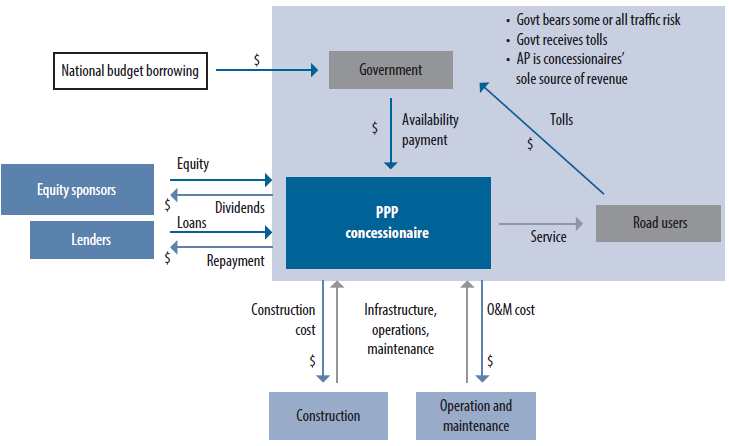
Availability payments provide more certainty of revenues to investors, with the Government as obligor (which may help the project access cheaper debt). While the downside risk is largely absorbed by the Government through this payment stream, the upside potential of high profits from tolls or tariffs will also belong to the Government, potentially reducing the incentives on the private investor to ensure success of the project.
The Government can also pre-purchase, or promise to purchase, a certain amount of output. For example, a fibre-optic network may have a clear advance commitment by the Government to purchase a portion of the network's capacity. Such payments generally reduce demand risk, and provide a guaranteed revenue stream, which in certain cases can be used as collateral for debt.