Institutional Arrangements
Just as PPPs are regulated in different ways, the development of PPPs can take place within different institutional arrangements. A typical consideration when assessing the PPP institutional framework is whether a PPP unit exists. A PPP unit is defined as "any organisation set up with full or partial aid of the government to ensure that necessary capacity to create, support, and evaluate multiple public-private partnerships agreements [is] made available and reside[s] in the government."21
Given the complexity of PPPs, establishing a PPP unit may support the development of PPPs but in itself is not a guarantee of success. Consequently the analysis does not score an economy on the basis of whether it has not created a PPP unit. Nonetheless, the analysis found that PPP units are common among the surveyed economies, being present in 85 percent of them.
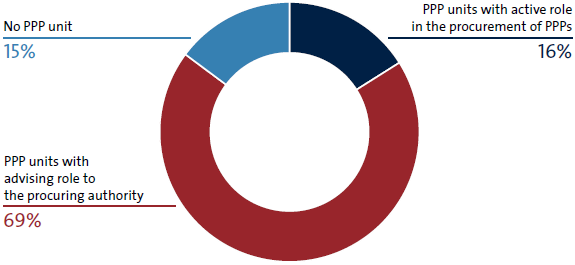
The functions and roles of PPP units (figure 4) vary across the economies surveyed. It is particularly interesting that in 16 percent of the economies, the PPP unit not only provides advice to the procuring authorities on the stages of the procurement process but also takes a more active role in the procurement of PPPs. In those cases, a PPP unit can either be exclusively responsible for PPP procurement (as in Honduras, where Coalianza is the only public agency that can procure PPPs)22 or conduct it jointly with the procuring authority (as in the Arab Republic of Egypt).23
Figure 4 Type of PPP institutional arrangement adopted (percentage, N = 82)
Note: PPP = public-private partnership.
Source: Benchmarking PPP Procurement 2017