Preparation of PPPs
Before deciding whether to launch a PPP procurement process, procuring authorities need to devote time and resources to ensure that such a choice is justified and that the project is ready for market. This effort includes the identification and appraisal of projects suitable to be developed as PPPs and the structuring and design of a draft PPP contract and approvals. This process is crucial to attain properly structured PPP projects that are more likely to both provide value for money to the government and be commercially viable. However, PPPs are often hastily formulated, with little financial means or technical help.24 The dearth of well-prepared PPP projects is one of the main challenges faced by emerging markets in attracting private sector operators and better leveraging private financing.
This PPP preparation phase includes several stages, starting with the identification of strategic infrastructure projects that could be developed as PPPs. For this purpose, projects must be identified and prioritized on the basis of an integrated infrastructure plan and rigorous economic cost-benefit analysis. Then feasibility studies should be conducted to ensure that a particular project can succeed as a PPP. Further assessments should be undertaken to inform the structure of the PPP project, including assessing and deciding on the allocation of risks and studying the market's appetite and capacity to accept them.25 Finally, on the basis of the PPP structure resulting from the appraisal process, the procuring authorities must formulate the documentation required to launch the PPP procurement process, including the draft PPP contract. Within all of this work, it is also important to understand the approval process-in particular whether there is a role for the ministry of finance or other government agencies or ministries that have a cross-cutting mandate. The recognized good practices that emerge during PPP project preparation are summarized in box 2.
Box 2 Good practices in the preparation of PPPs |
Good practices which help ensure that the decision to procure a PPP is justified and that the procuring authority is ready to initiate the procurement process are: |
• The Ministry of Finance or central budget authority approves the long term financial implications of the project. |
• The project is assessed and prioritized along with all other public investment projects in the context of the national public investment plans. |
• The project is adequately justified, on the basis of: |
> Socioeconomic analysis; > Fiscal affordability assessment; > Financial viability; > Risk assessment; > PPP vs. public procurement comparative assessment; > Market assessment; • The procuring authority prepares a draft PPP contract and includes it in the request for proposals. |
• The procuring authority has standardized PPP model contracts and/or transaction documents to expedite and guarantee consistency. |
Note: PPP = public-private partnership.
Benchmarking PPP Procurement shows regional and income group differences in the average score for the preparation of PPPs (figure 5). The OECD high income region stands out from the rest of the regions. ECA and SAR regions score just above average and interestingly they are the regions with the lowest intraregional variance. When disaggregating the data by income level, there is a clear pattern showing that the lower the income group level, the lower the average scores on project preparation.
Figure 5 Preparation of PPPs, score by region and income group (score 1-100)
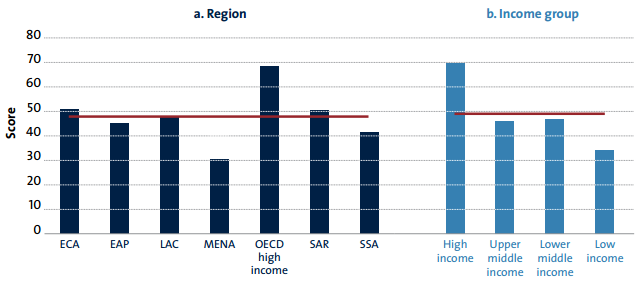
Note: EAP = East Asia and Pacific; ECA = Europe and Central Asia; LAC = Latin America and the Caribbean; MENA = Middle East and North Africa; OECD = Organisation for Economic Co-operation and Development; PPP = public-private partnership; SAR = South Asia; SSA = Sub-Saharan Africa. Source: Benchmarking PPP Procurement 2017
To assess the extent to which PPP regulatory frameworks in different economies cover the need to conduct this preparatory work before launching a PPP, the Benchmarking PPP Procurement survey inquired about the approval process for PPPs, the process of PPP prioritization, and their appraisal in all relevant dimensions (socioeconomic impact, affordability, value for money of the PPP alternative, commercial viability including bankability, and the like), as well as aspects of the preparation of the PPP draft contract. The survey also included a pilot assessment of the responsibility to obtain the land and permits required to develop and operate a PPP project. Whereas the data gathered offers a rich set of findings across the economies measured, the following subsections briefly detail the study's results related to approvals, prioritization of PPP projects, and their appraisal.