Prioritization of PPP Projects
A PPP is a method of infrastructure delivery that is an alternative to conventional procurement. Regardless of how infrastructure projects are procured, they should be identified and prioritized in the context of each economy's public investment planning process.28 As a consequence, PPPs should emerge from this broader public investment planning and project selection process. This process usually involves a socioeconomic analysis and ensures that PPP projects are subject to the same level of scrutiny as any other public investment project. Only later in the process should projects be screened for their potential for implementation through PPPs and further assessment be carried out to determine their viability as PPP projects.
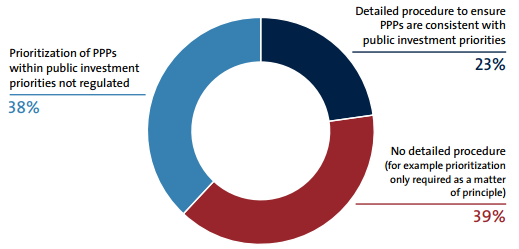
Benchmarking PPP Procurement finds that, overall, practices within the economies surveyed leave considerable room for improvement. For instance, in only 23 percent of the economies does the regulatory framework actually detail a procedure for ensuring that the identification and prioritization of PPPs is consistent with public investment priorities (figure 6). In the Philippines, for example, procuring authorities must (a) prepare infrastructure or development programs to identify specific priority projects that may be developed as PPPs; (b) ensure that the list of priority projects is consistent with the Philippine Development Plan, the Provincial Development Plan, and the Physical Framework Plan; and (c) submit the list to the National Economic and Development Authority Board or the Investment Coordination Committee for approval.29 Similarly, in Kenya, the procuring authorities are required to prepare a pipeline of PPP projects in line with their development plans. The PPP pipeline is then submitted for assessment and approval by the PPP Unit, the PPP Committee, and the National Cabinet.30 Peru has an especially precise mechanism for including PPPs in the context of public investments; identifying their importance in national, sectoral, regional, and local priorities; and declaring them to be viable within the scope of the SNIP (National Investment System).31
Figure 6 Consistency between prioritization of PPP projects and public investment priorities (percentage, N = 82)
PPP = public-private partnership.
Source: Benchmarking PPP Procurement 2017
In 39 percent of the economies, prioritizing PPPs among other public investment projects is required as a matter of principle or done in practice, but the provisions do not detail a specific process to follow, leaving the implementation of this requirement to the discretion of procuring authorities. For example, in Pakistan, PPP projects are to be screened and evaluated, including by the Planning Commission, "to ensure consistency with the Government of Pakistan infrastructure policy/strategy."32 In the remaining 38 percent, the prioritization of PPPs within public investment priorities is not regulated, and it is not clear how these economies ensure consistency in prioritization between PPPs and their broader investment program.