Assessments of PPPs
Before deciding to initiate a PPP procurement, the procuring authority needs to answer a set of key questions related to affordability, risk allocation, commercial viability, and value for money to ensure that the PPP option is feasible. Also, this assessment process ensures that all of the critical characteristics of the project are understood by the procuring authorities, enabling them to properly structure the project and design the draft PPP contract.33
To capture the extent to which economies follow this practice, Benchmarking PPP Procurement assesses whether the PPP regulatory framework has included requirements to (a) assess the socioeconomic impact of the project, (b) appraise its affordability, (c) identify and allocate the risks, (d) determine bankability, (e) conduct a comparative assessment with the traditional procurement options, and (f) conduct market assessment.
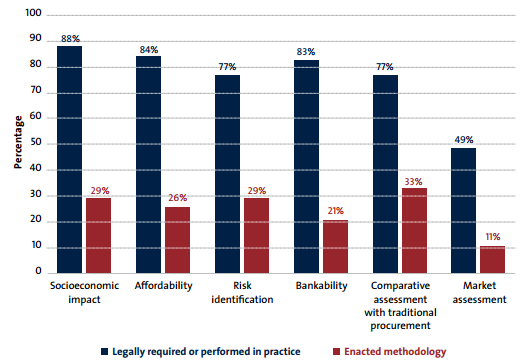
Whereas in approximately two-thirds of the economies surveyed there are legal requirements to conduct assessments of socioeconomic impact, affordability, risk identification, and bankability as well as comparative assessments (figure 7), only about one-third of these economies have adopted a specific methodology for conducting such assessments. Although having a legal requirement is usually a first step necessary to ensure that these assessments are conducted, establishing a clear methodology is also needed to enable the procuring entity to conduct assessments consistently across projects and to enhance the quality and reliability of the analysis. In the worst-case scenario, the lack of a specific methodology might point either to (a) studies that are carried out to formally comply with the legal requirements without actually providing the critical information needed for cognizant decision making or (b) a lack of implementation of the legal requirements in place.
Figure 7 Assessment during PPP preparation phase (percentage; N = 82)
PPP = public-private partnership.
Source: Benchmarking PPP Procurement 2017
Of the 82 economies analyzed, the Dominican Republic and Lebanon are the only economies that do not legally require any assessment to be conducted before a PPP is procured. At the other end of the spectrum, Lithuania, the Philippines, South Africa, and Vietnam legally require all the mentioned assessments and also have enacted specific methodologies to conduct those assessments. In 88 percent of the economies, the procuring authorities conduct socioeconomic impact assessments before tendering a PPP project. However, only 29 percent of the economies have developed a specific methodology for how to perform the socioeconomic impact assessment. Uruguay is a good example of an economy with a detailed methodology for a socioeconomic impact assessment: the Planning and Budget Office has made available supporting material and methodological guidelines, including a guide for the design and evaluation of investment projects.34
When it comes to affordability assessments, 84 percent of the surveyed economies conduct them, but only 26 percent of the economies have enacted a specific methodology for doing so. In some economies, this assessment is conducted directly by the ministry of finance, as in Cameroon,35 or the PPP unit, as in Argentina,36 or by the procuring authority under the supervision of the ministry of finance, as in Moldova.37 To ensure that long-term commitments are indeed studied, some economies define a fixed period of time to analyze: for example, Timor-Leste requires forecasts of future payments and revenues for the next 25 years.38 In Chile, the Ministry of Finance must keep track and elaborate a yearly report on the contingent liabilities arising from concessions,39 and Colombia has developed a manual on contingent liabilities that contains a methodology for calculating the fiscal impact of PPPs.40
A similar finding applies to risk assessments, which are conducted in 77 percent of the surveyed economies, but only 29 percent of them have adopted a methodology for identifying and allocating risks. Whereas in some economies these methodologies are limited to a list of risks to be assessed, as in the Arab Republic of Egypt,41 others have prepared a more comprehensive risk matrix. This is the case, for example, in the Philippines, where the Generic Preferred Risk Allocation matrix indicates the type of risks to be assessed and also includes definitions, proposed allocations and rationales, possible risk mitigation efforts, and suggested contract provisions.42
Similarly, 83 percent of the economies mandate assessment of the financial viability or bankability of the project. Nevertheless, only 21 percent of the economies follow a specific methodology for assessing the bankability of the PPP project. This is the case, for example, in Colombia, where the National Planning Department and the Ministry of Finance have developed several guides for assessing a project's bankability.43
Of the 82 economies, 77 percent require a comparative assessment to be conducted between PPP and traditional procurement.However, only 33 percent have enacted a methodology detailing its preparation. In Brazil, the approval to procure a PPP must be based on a study showing the convenience of and opportunity for procuring a PPP by identifying the reasons that justify the choice of the form of the PPP.44
Market assessment is the least commonly required appraisal among the surveyed economies. It is conducted in only half of the economies (including 12 percent that do so without a legal requirement), and only 11 percent have a specific methodology. In the Philippines, for example, the PPP Center and the procuring authority must perform a market-sounding process to determine the interest of private sector operators, taking into account different scenarios for revenue and economic growth in the short, medium, and long terms.45