Period of Time Granted to Bidders to Submit Bids
Given the complexity of PPP contracts, bidders need to be granted enough time to prepare their proposals once the call for tenders is made public. Short periods for bid preparation may deter potential bidders from participating in the PPP procurement process if it is unlikely that they will be able to carry out the due diligence necessary to prepare high-quality proposals.47 The time granted to present proposals is usually defined on the tender notice or other tender documentation. Regulatory provisions setting a minimum period of time in which to present the proposals ensure that the procuring authorities do not have absolute discretion on the matter, creating a fairer system for all bidders. Under no regulatory constraints, procuring authorities could legally reduce the time granted to prepare proposals in such a way that competition would be discouraged or even intentionally driven out of the PPP procurement process.
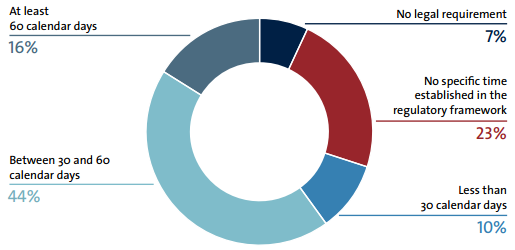
In 93 percent of the surveyed economies,48 there is either a regulatory provision or a generally followed practice that grant bidders a minimum period of time to prepare and submit their bids (figure 9). That being said, the mere enactment of a legal provision that guarantees a minimum period of time is not enough. In fact, in 23 percent of the economies, the procuring authority still has the discretion to decide how long the period should be, which leads to a lack of predictability for bidders.
Figure 9 Time granted to potential bidders to submit their bids (percentage; N = 82)
Source: Benchmarking PPP Procurement 2017
When such a period is set in the law, it can range from less than 30 calendar days, as in Argentina, Honduras, India, and Lebanon, to 90 days or more, as in Chile, the Republic of Korea, the Philippines, Sri Lanka, Tanzania, Uruguay, and Vietnam.