Lack of Competition: Sole-Bidder Scenario
Competition is crucial to obtain good value for money from the PPP procurement process. Ultimately, on top of all the assessments conducted during the preparation of a PPP, the potential for success of the project is subject to a final "market test" during the procurement process. As a consequence, receiving only one bid can raise concerns about whether the project is actually suitable as a PPP and whether such a bid will provide the best value for money. As a general rule, "even when only one bid is submitted, the bidding process may be considered valid, if the bid was satisfactorily advertised, the qualification criteria were not unduly restrictive, and prices are reasonable in comparison with market value."49 However, in theory, depending on the reason for receiving only one bid, there are generally two additional options: (a) retendering, which is recommended when the low turnout is caused by a deficiency in the procurement process itself, or (b) conducting thorough due diligence to ensure that the bidder is in full compliance with the all of the requirements.50 Whatever the approach, receiving a single bid may be problematic and thus merit attention through the PPP regulatory framework.
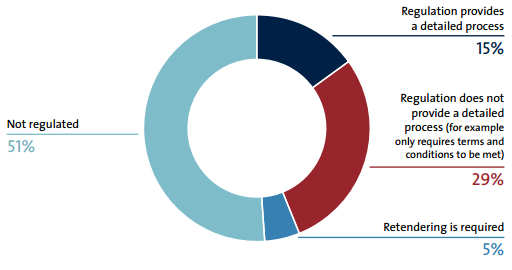
Despite the relevance of this aspect and its potential impact on the result of the PPP procurement process, in half of the economies measured, the PPP regulatory framework does not address this issue at all. For example, in Kenya, Peru, and Senegal, when the procuring authorities receive a sole proposal, they are not required to follow any specific procedure before awarding a PPP contract. Among the economies that address the issue, the Kyrgyz Republic, Madagascar, Tajikistan, Tanzania, and Tunisia do not allow the award of a PPP project when only one proposal is presented, instead automatically requiring retendering. In the majority of the remaining economies, provisions in the PPP legal framework simply state that sole bidders are acceptable as long as all the terms and conditions are met, without specifying further details regulating the matter (figure 10).51
Figure 10 Approach to addressing cases when only one bid is received (percentage; N = 82)
Source: Benchmarking PPP Procurement 2017
Only in 15 percent of the economies is the issue of sole bidders regulated with greater detail.52 In those economies, the law mandates a special procedure that needs to be followed before awarding the PPP project. This is the case, for example, in the Arab Republic of Egypt, where the regulatory framework specifies the conditions and process for accepting sole bids. A single bid may be accepted through a decision by the competent authority based on the recommendation of the bid evaluation committee, after the approval of the Supreme Committee for PPP Affairs, if the public interest does not allow for retendering procedures, or if retendering would be futile, and if the sole bid is technically acceptable and meets the specifications of the tender.53 Similarly, in Nigeria, although the regulatory framework allows for direct negotiation with a sole bidder,54 it requires the procuring authority to ensure that the bid is technically and financially advantageous compared with market prices and to include, in the record of procurement proceedings, a statement of the grounds for its decision and the circumstances justifying the single-source procurement.55