Transparency and Disclosure of PPP Information: Publication of the Award Notice and PPP Contract by the Procuring Authority
Transparency in the PPP process may help achieve better value for money by strengthening governance and improving the management of fiscal cost, by producing more sustainable contracts, by reducing the risks of renegotiation, and by resulting in a better understanding of the impact on service delivery.56 It is therefore advisable to establish procedures that ensure the dissemination of the tender notice, disclosure of the outcome of the procurement process, and publication of contract information. Wide publicity about the key decisions of the PPP procurement process ensures openness and fairness and enhances competition. Furthermore, PPP contracts often include provisions that have a direct impact on parties other than the procuring authority and the selected bidder, who have a legitimate interest in being informed about the essential elements of the contract.
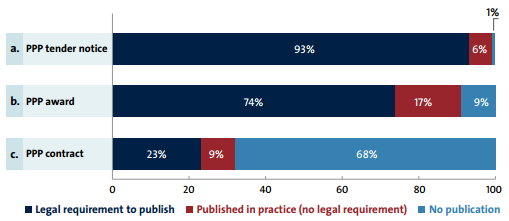
There is a clear move toward publishing information about PPP tenders and award notices (figure 11), with widespread use of online means of publication. Of the economies that do publish tender notices, only 11 percent do not publish them online. For award notices, 79 percent of the economies make them available online. Ecuador, Lebanon, Mongolia, and a few other economies remain the exception to the rule, as publication of the award notice is neither mandated by law nor a regularly followed practice, which makes the final step of the private partner selection less transparent.
Figure 11 Access to information during PPP procurement (percentage, N = 82)
Note: PPP = public-private partnership.
Source: Benchmarking PPP Procurement 2017
The situation is different when it comes to publication of the PPP contract, which occurs in only 24 percent of the economies. Some, such as Colombia and Portugal, publish the signed PPP contract online in its entirety. However, other economies opt to publish summaries of PPP contracts that present their complex provisions in plain language, making the contracts easier for the public and third parties to read.57,58
Box 4 Interactions with bidders throughout the PPP procurement process |
After a call for tenders is issued, bidders will prepare proposals that are based on the requirements detailed in the tender documents. During this process, the procuring authorities need to define how and to what extent they will interact with bidders as they prepare their proposals. Rules governing the process and permissible topics for interaction with bidders are usually set in the tender documents, thus safeguarding the transparency and fairness of the procurement process. Interactions between bidders and the procuring authority can range from a mere exchange of information to an interactive dialogue and in-person meetings and conferences. |
Except in Algeria, the Republic of Congo, Indonesia, Madagascar, Papua New Guinea, Thailand, and Togo, all the economies measured allow interested suppliers to request clarifications about the tender documents (public procurement notices, requests for proposals, and the like). Although the majority of the economies make communication outcomes publicly available, doing so is not required in economies such as Cameroon, the Democratic Republic of Congo, Gabon, Iraq, Mongolia, Ukraine, and Zambia. |
In some economies, procuring authorities can also use a "competitive dialogue" procedure, which involves more extensive engagements with two or more bidders as they prepare their proposals. In this procedure, bidders submit technical proposals, which are then subject to feedback and discussion with the procuring authority. These discussions allow them to align their proposals with the authority's needs before they submit a final proposal.a In 45 percent of the surveyed economies, competitive dialogue either is allowed by law or takes place in practice. The latter case can be seen in Bangladesh, Canada, Jamaica, Myanmar, and the United States. Even where competitive dialogue is possible, its content and results are not always disclosed to all potential bidders, as in Armenia, Cameroon, Côte d'Ivoire, and the Arab Republic of Egypt, where there are no requirements for such disclosure of information. |
Interaction with bidders should also be regulated during the period after the award of the contract and before its signature. Negotiations should be broadly restricted and regulated according to international good practices to prevent undermining the competitive tendering process and distorting the criteria by which the proposals were evaluated. In 43 percent of the surveyed economies, the regulatory framework does not restrict or regulate negotiations with the selected bidder in any way during the period between the award and the signature of the PPP contract. In contrast, economies such as Bosnia and Herzegovina forbid such negotiations outright. Between these two approaches some economies expressly regulate negotiations in an effort to ensure fairness for all bidders. In Australia, for example, a negotiation parameters schedule is developed prior to any negotiations. This schedule explains any departures from the commercial principles underpinning the tender documentation.b |
a. World Bank 2014, section 3.5.4. b. Australia, section 4.4.1, New South Wales PPP Guidelines of 2012. |