Evaluation of Unsolicited Proposals
Because USPs do not originate as part of a government planning process, it is not always sufficiently clear whether a USP is in line with an economy's investment priorities. Moreover, an intense use of USPs could create a situation in which governments, rather than using a planned approach to dealing with infrastructure needs, rely on the private sector to identify those needs.61 Furthermore, most USPs also require government financial support. Consequently, when approving USPs, governments may be in a position in which they are accepting contingent, or even direct, liabilities associated with the project. This is even more problematic in situations in which the private sector may not be sufficiently diligent when assessing the risks that would be borne by the government. If a government fails to adequately evaluate a USP project and the associated risks, it could be left in a precarious position. Proper evaluation of USPs is thus essential to ensure both that they are aligned with the investment needs of an economy and that, if they require public support, they constitute a good use of public resources.
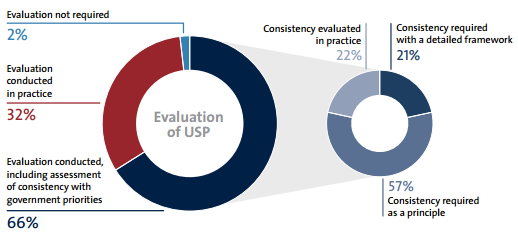
All but one of the 56 economies that regulate the submission of USPs conduct an evaluation of such proposals. The exception is Cameroon, where the regulatory framework does not explicitly require the procuring authorities to evaluate USPs. However, provisions regulating the evaluation of USPs do not always address the need to ensure that the project is consistent with government priorities. This is the case of 32 percent of the economies, including Bosnia and Herzegovina, Kazakhstan, Malawi, Pakistan, and Papua New Guinea. Although 66 percent of the economies do require USPs to be consistent with existing priorities, only 21 percent of them have established detailed procedures for evaluating USPs. Figure 13 shows the prevalence of different approaches to evaluating USPs among the 56 economies that regulate them.
Figure 13 Approaches to evaluation of USPs (percentage, N = 56)
Note: USP = unsolicited proposal.
Source: Benchmarking PPP Procurement 2017
Given the merits that USPs often have and recognizing the risks associated with them, some governments have developed systems for their evaluation. In Nigeria, for example, there are detailed provisions related to the evaluation of a USP and its alignment with government priorities. The USP is submitted to and reviewed by the relevant ministry, department or agency, which is required to review the proposal to ensure that it meets criteria, such as whether the project serves the public interest. Following its review, it forwards the proposal to the Infrastructure Concession Regulatory Commission (ICRC) for review and issuance of a finding of "no objection" to evaluating whether the proposal is satisfactory.62 Similarly, in Uganda, the contracting authority is required to evaluate USPs in terms of "the unique innovative, researched, or meritorious methods, approaches, or concepts demonstrated in the unsolicited proposal, overall scientific, technical, or socioeconomic merit of the unsolicited proposal." Furthermore, the procuring authority also examines the potential contribution of the USP to the strategic objectives in the government's development plan. In short, this obliges the contracting authority in Uganda to identify whether the proposal fits these strategic objectives.63