Competitive Bidding and Minimum Time Limits
Having a competitive procedure increases the likelihood of obtaining better value for money from a USP project. In addition, having a clear competitive mechanism in place when dealing with USPs enhances the transparency of the process and helps governments mitigate pressures from the private sector and special interests to accept a USP. In fact, much of the controversy about USPs stems from governments granting exclusive development rights to private proponents without a transparent tendering process. The lack of a transparent, competitive process could lead to corruption and, thus, the development of projects of questionable quality. Moreover, it could lead to complaints if other parties feel that a private company is unfairly benefiting from a PPP, which will in turn lead to a loss of future trust and support for PPPs in an economy.64
In addition to being given access to a competitive procedure, other potential bidders should be provided an adequate amount of time to prepare and submit their proposals. A short time limit for submitting proposals could deter other private sector parties from submitting bids. The original proponent of the USP would have an advantage in such a case, because it had enough time to conduct proper due diligence when preparing the USP. A tight deadline therefore deters other parties from participating, hence distorting competition and, thus, potentially reducing the obtained value for money.
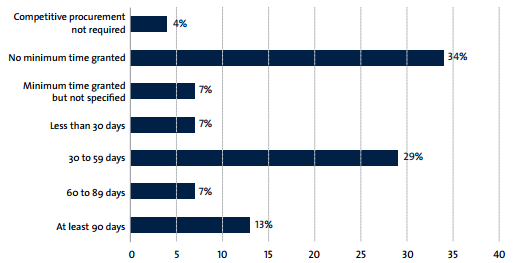
Of the economies that regulate the use of USPs, only 2 do not require a competitive procedure for procuring them: Kenya and Vietnam (figure 14). 56 percent guarantee a minimum legal period of time for the submission of proposals. However, the duration of this period of time varies widely, from a mere 15 days in China to 180 in Colombia. There is no clear consensus as to what constitutes a reasonable period of time to allocate to additional bidders. However, the literature and procurement experts argue that a period of 60 days or less is unlikely to provide additional proponents with enough time to conduct the necessary due diligence and come up with a high-quality proposal.65
Figure 14 Time granted to additional bidders in competitive procurements triggered by USPs (percentage, N = 56)
Note: USP = unsolicited proposal.
Source: Benchmarking PPP Procurement 2017
Some economies have rules specifically governing the competitive tendering of a USP, while others prescribe that once a USP is approved, the procuring authority must follow the regular open competitive procedure. In Peru, for example, once a USP is accepted, the procuring authority provides potential new bidders with a period of 90 calendar days to submit expressions of interest in developing the project. After the 90-day period elapses, if other parties are interested in bidding for the project, the procuring authority initiates a competitive PPP procurement procedure; otherwise, it carries out direct negotiations with the original proponent.66 Similarly, in Jamaica, potential additional bidders are given 90 days to submit bids after a USP has been accepted,67 In contrast, in Albania, the minimum time provided to bidders interested in USPs or government-initiated projects is the same, because USPs approved by the procuring authorities are governed by the same competitive procedure as government-initiated projects. Thus, regardless of the origin, when concessions for public works are tendered, the deadline for submission of offers is not less than 30 days from the date of publication of the procurement notice.68