Mechanisms for Compensating the Original Proponent
The most effective way to deal with USPs is to use an open and transparent competitive process.69 However, because the original proponent incurs costs in the preparation of a USP, the lack of an appropriate compensation mechanism may deter the submission of USPs should a competitive solicitation be required. Having such compensatory mechanisms in place encourages the private sector to approach the government with proposals that are not advertised.70 For instance, if proponents know that they will be reimbursed for developing the proposal, which can be costly, they are more likely to come forward with a proposal. Yet if the reimbursement fees are overly generous, firms could potentially come up with frivolous proposals. As for USPs in general, currently there is no clear consensus as to whether compensation mechanisms should be used at all. Consequently, the data collected by the Benchmarking PPP Procurement project are used merely for contextual purposes, to advance the understanding of the use of these instruments worldwide.
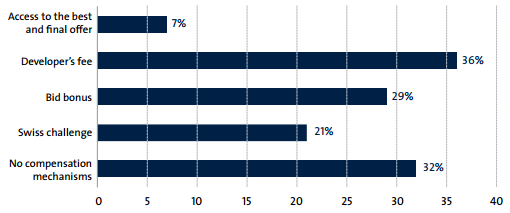
Currently, four main mechanisms are used to compensate USP developers: (a) access to the best and final offer (ABFO)71 in 7 percent of the economies, (b) developer's fee72 in 36 percent of the economies, (c) bid bonus73 in 29 percent of the economies, and (d) Swiss challenge74 in 21 percent of the economies. The developer's fee remains the most commonly employed mechanism, followed by the bid bonus system and the Swiss challenge system (figure 15).
Figure 15 Use of mechanisms to compensate USP original proponent (percentage, N = 56)
Note: USP = unsolicited proposal.
Source: Benchmarking PPP Procurement 2017