PPP Contract Management
There can be a tendency to consider that once the PPP contract is signed and the financial close reached, the main task is completed. In reality, however, the signature of the PPP contract and financial close mark the beginning of the implementation of the project. It is in fact the success of this implementation that will determine whether the project delivers the expected value for money. As a consequence, it is absolutely key to establish a sound PPP contract management system to oversee the implementation of the PPP contract.
Given the long-term nature of PPPs, adequate preparation and procurement alone do not guarantee success. Well-established contract management systems are necessary to provide for a sustained, smooth implementation process. In this sense, PPP contracts should be designed to anticipate and regulate as many as possible of the circumstances that could arise during the life of the project. Moreover, the PPP contract should also put in place contract management tools to address unexpected circumstances.75 A sound PPP contract management system not only supports a smoother implementation of the project but also embodies the legitimate expectations of the parties and helps ensure that they are met.
To assess whether enough attention is devoted to the PPP contract management stage, this section considers the extent to which regulatory frameworks and generally followed practices establish adequate oversight mechanisms and ensure that the PPP contract is as comprehensive as possible. With that goal, it measures aspects such as monitoring and evaluation mechanisms for PPPs, changes to the structure of the private operator and renegotiation of the PPP contract, and dispute resolution mechanisms, as well as contract features such as lenders' step-in rights and termination and its consequences. Recognized good practices applicable during the PPP contract management are summarized in box 6.
Box 6 Good practices in PPP contract management |
Good practices to ensure a successful implementation and delivery of the PPP project are: |
• The procuring authority establishes a system to manage the implementation of the PPP contract including establishing a PPP contract management team, involving some of its members in the project since the procurement stage, offering the possibility to consult PPP procurement experts and adopting PPP implementation manuals; |
• Monitoring and evaluation systems of the PPP contract are established with risk mitigation mechanisms and performance information is made publicly available; |
• Potential changes in the structure of the private partner are expressly regulated requiring the replacing entity to be at least as qualified as the original private partner; |
• Modification and renegotiation of the contract are expressly regulated to reduce incentives to use it strategically by either the private partner or the procuring authority; |
• Specific circumstances (force majeure, material adverse government action, change in the law, refinancing) that may arise during the life of the contract are expressly regulated; |
• Dispute resolution mechanisms are in place allowing the parties to resolve discrepancies in an efficient and satisfactory manner; |
• Lenders are given step-in rights in cases when the private partner is in risk of default or if the PPP contract is under threat of termination for failure to meet service obligations. |
• Grounds for termination of the PPP contract and its associated consequences are well defined. |
Note: PPP = public-private partnership.
Benchmarking PPP Procurement findings show regional and income group differences in the average score for PPP contract management (figure 16). The OECD high income region leads in this area, followed by the LAC region. Contract management scores vary from 0 to 88 points over all 82 economies with EAP region presenting the largest intraregional variation. When the data are disaggregated by income level, there is a clear pattern showing that, when it comes to contract management, the lower the income group level is, the lower the average scores are.
Figure 16 PPP contract management, score by region and income group
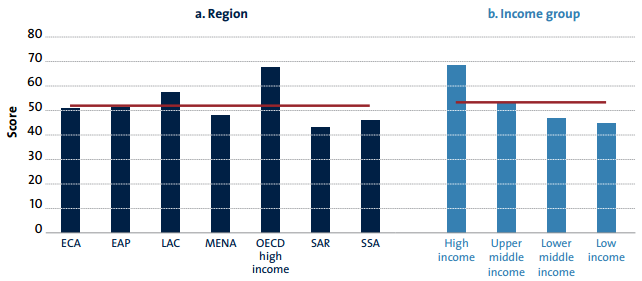
Note: EAP = East Asia and Pacific; ECA = Europe and Central Asia; LAC = Latin America and the Caribbean; MENA = Middle East and North Africa; OECD = Organisation for Economic Co-operation and Development; PPP = public-private partnership; SAR = South Asia; SSA = Sub-Saharan Africa.
Source: Benchmarking PPP Procurement 2017
The following summary of the findings focuses on monitoring and evaluation tools, renegotiation of PPPs, dispute resolution mechanisms for PPPs, and lenders' step-in rights (box 7).