Monitoring and Evaluation Systems
Given the prolonged engagement typical of PPP projects, the government's ability to monitor the project during the construction and operation phase is critical. The procuring or regulatory authority needs to ensure, by regularly monitoring outputs and service standards, that the private party meets its obligations under the PPP contract. This means monitoring actual performance against the performance indicators established in the contract.76 Doing so enables better delivery of services and ensures that the government is obtaining the best value for money through the contract.
93 percent of the surveyed economies address the need to monitor the PPP contract during implementation.77 In a number of them, the regulatory framework calls for the establishment of teams to monitor PPP contract performance. In Colombia, implementation of the PPP contract is supervised by two authorities: an auditor (which is a third party in charge of overseeing the contract's development directly) and a contract management team (which acts as a supervisor of the contract within the procuring authority).78 In other economies, such as Costa Rica and Ecuador,79 although the need for monitoring and evaluation of PPPs is acknowledged, no explicit institutional arrangement is established for conducting the monitoring and evaluation.80
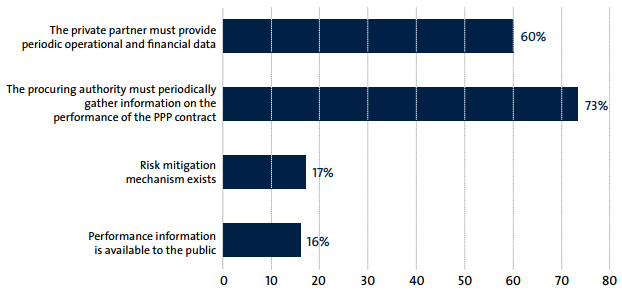
Regarding the specific monitoring and evaluation mechanisms in place, as shown in figure 17, in 73 percent of the 82 economies, the procuring authority must periodically gather information about the performance of the PPP. To further promote transparency in the PPP contract execution and to increase the accountability of both parties for the contract, operational and financial data as well as performance information should be made available to the public. Brazil, Mexico, and the Republic of Korea are among a small sample of economies (16 percent) that mandate such publication.
Figure 17 Legal requirements for specific monitoring and evaluation mechanisms (percentage; N = 82)
Note: PPP = public-private partnership.
Source: Benchmarking PPP Procurement 2017
Another tool for monitoring the performance of the contract is the establishment of risk mitigation mechanisms.81 Like the publication of information, the use of such a mechanism remains isolated. In only 17 percent of the economies does the regulatory framework address the need to establish a risk mitigation mechanism. This is the case, for example in Australia (in New South Wales), where the law clearly states that "as risk is a dynamic concept, contract management must evolve with the delivery of the contracted services throughout the project lifecycle."82