1.1 CONSTRAINTS OF CURRENT MODELS
The lack of understanding amongst those implementing PPP and those external to the PPP process endeavoring to assess whether PPP is a good thing is exacerbated by the use of terms of art that are at best inexact. Even the French terms like "concession" and "affermage" defined over the centuries by French administrative law have lost their strict meaning outside of France.
Generic terms for private sector involvement in the provision of infrastructure services, such as PFI, private concession, privatization and PSP can have complicated and unhelpful connotations. "PFI" tends to mean a specific UK model, "private concession" is confused with the English, French and a variety of Latin American models of concessions. Significant PPP projects have been delayed by debates over whether a "concession" or a "lease" or a "management contract" should be used. These debates often become matters of institutional philosophy or pride, yet their meaning is rarely unpacked and is often misunderstood. Often both sides of the debate intend the same result, but use different labels. The misuse of the term "privatization" and the difficulty in analyzing its relative advantages and disadvantages suffers from many of the same challenges.
A number of efforts have been made to order PPP. For example, in different books and articles this author used a field, with points plotted on it trying to indicate how different PPP structures might fit in the context of responsibility for service provision and control of assets. While the implication was that PPP is ultimately flexible, evidenced by the use of a field, the implication is still that the relevant terminology actually means something specific. (See Box 3).
The terms in the diagram above are some of those frequently used in PPP: • Management or operation and maintenance (O&M) contract - where a private entity provides some operation and maintenance services for a fee, usually based on delivering satisfactory services. • Affermage - where a private entity builds and/or refurbishes and operates a service usually delivered directly to consumers, and the grantor finances any major capital expenditure. The private entity generally collects tariffs directly from consumers. • Build-Operate-Transfer (BOT), Build-Own-Operate (BOO), Build-Own-Operate-Transfer (BOOT), Design-Build-Finance-Operate (DBFO), Design-Construct-Manage-Finance (DCMF) - where a private entity finances and builds/refurbishes a facility that provides services to a single or small group of large offtakers (often a public utility) or directly to consumers (e.g. toll roads). • Lease - where existing assets and/or land is leased to a private entity for construction of assets to provide services to offtakers or directly to consumers. • Concession - where a private entity finances and builds and operates a service usually delivered directly to consumers. Divestiture is where the assets are sold to a private entity, who provides services directly to consumers. | ||||||||||||||||||||||||||||||||||||||||||||||||||||||||||||||||
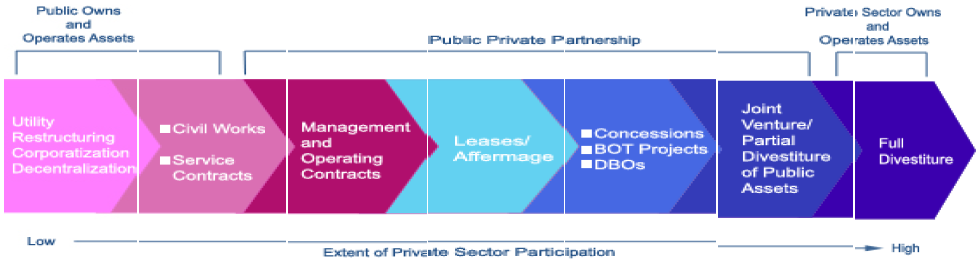
Another popular approach is to plot the forms of PPP against a continuum (see Figure 1) - this model is used for the World Bank's PPP Resource Center Website6, the UNCITRAL model law7, PPIAF PPP toolkits8 and others. Similar to the field discussed above, the continuum endeavors to show the flexibility of PPP, and the lack of clear delineation between different forms of PPP, by demonstrating the movement of PPP structures across the continuum. However, it clearly provides only very rough classification against the general concepts of private sector risk and control. It also implies that the sub-parts of the continuum are subject to clear and exact definition.
Each of the existing structures endeavors to capture the flexibility of PPP while providing the order and structure, despite the lack of clarity. While good pedagogical tools, these tables are not useful for analytical purposes, and would not achieve the aims set out above.
The creation of a practical, descriptive terminology will help
i) Reinvest PPP with the innovative and creative capacity that it is meant to embody
ii) Facilitate analysis and comparison across sectors and regions, permitting lessons learned to cross these often confusing barriers
iii) Decouple terms of art from specific examples whose specificity may influence assessment of other similarly named but fundamentally different structures.
This paper proposes a categorization model, i) a snap shot of the most important characteristics of a PPP project, while ii) maintaining the simplicity necessary for it to function effectively. These twin functions necessitate including only the absolutely critical characteristics of PPP in the model.
| Figure 1
|
______________________________________________________________________________