8.3 Interview Participants
The interviewing process was conducted between October 2012 and March 2013. Fifty invitations were distributed and 34 people (68% response rate) agreed to participate in the formal process. Of the remaining 16, eight invitees declined to participate and a further eight did not respond. Twenty-three participants (68%) were from the public sector and 11 (32%) from the private sector. Seven respondents took part in a second interview involving a different management discipline i.e. partnership, risk or performance management, bringing the total to 38 interviews (three interviews involved interviewing two participants at the same time and one of these respondents took part in a second interview).
As discussed in Chapter 2 (see '2.3.4 Method'), the sample size for this research was determined retrospectively through identifying the 'saturation point' i.e. whereby saturation occurs when no new significant issues and diversity of answers are revealed during interview (Richards 2005: p.135-136; O'Leary 2005: p.114). This point was revealed through categorisation and analysis of transcript data e.g. by comparing and contrasting the findings for the possibility of developing new issues and sub-issues. The data analysis processes that were used are outlined in section 8.4 ('Data Analysis Processes'), below.
The majority of the public sector interview participants were project directors. They have responsibility for administering the public partner's interests in a PPP. However, a range of other government employees were invited to take part as it was anticipated that their experiences would impact on the design / refinement of the IMM. This included senior executives from central agencies, government departments and statutory authorities; a commercial manager; as well as a small number of PPP contract managers and a contract administrator. The research sample was drawn from eligible persons from the Australian Government, three Australian state jurisdictions and the UK Government. Furthermore, selected private sector participants were invited to offer insights into what they think the public partner should be mindful of during the operational phase of PPPs. The types of private sector participants included senior executives and managers responsible for PPP service delivery; project engineers; and partners from top-tier advisory and legal firms. Many of these participants have substantial experience working in Australian and international PPP markets.
Figure 8.1 below provides a summary display of the interviews by sector and by management discipline. The dominance of public sector interviewees is justified by their relevance to the thesis, which focuses upon the role of the public partner in the operational phase of PPP.
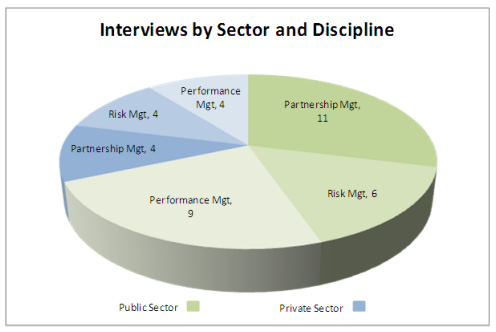
Fig. 8.1 Interviews by Sector and by Management Discipline.
The interviews consist of 15 meetings (40%) dealing with partnership management, 10 meetings (26%) about risk management and 13 meetings (34%) for performance management. For the public sector, 11 Participants (29%) spoke about partnership management, six (16%) about risk management and nine (24%) about performance management. From the private sector, 12 (30%) participants spoke about their experiences (four interviews each per management discipline).
Table 8.6 displays the interview administration demographics comprising interviewee identification code, interview duration and distinction between public and private sector PPP representation. Abbreviations in identification codes are as follows: pilot study (PS); partnership management focus (PT); risk management focus (RK); and performance management focus (PF).
Table 8.6 Interview Administration Demographics.
| Reference Number | Public or Private Participant | Participant Status | Interview Length (mins) | Subsequent Interview |
| PS03^ | Public | Senior Manager | 60 | - |
| PS04^ | Public | Contract Manager | 60 | - |
| PT01-PT02 | Private | Senior Manager (both) | 90 | RK03 |
| PT03 | Public | Director | 75 | RK05 |
| PT04 | Public | Executive Director | 45* | RK08 |
| PT05 | Public | Deputy Secretary | 60 | - |
| PT06 | Public | Director | 60 | RK11 |
| PT07 | Public | Director | 60 | - |
| PT08 | Public | Director | 90 | - |
| PT09 | Private | Partner | 60 | - |
| PT10 | Public | Director | 55 | PF08 |
| PT11 | Public | Director | 75 | - |
| PT12 | Private | Group Executive | 75 | - |
| PT13 | Private | Partner | 75 | - |
| PT14 | Public | Director | 60 | PF13 |
| RK01-RK02 | Public | General Manager (both) | 60 | - |
| RK03 | Private | Senior Manager | 90 | PT01 |
| RK04 | Private | Group Executive | 60 | - |
| RK05 | Public | Director | 75 | PT03 |
| RK06 | Private | Partner | 60 | PF01 |
| RK07 | Public | Director | 75 | - |
| RK08 | Public | Executive Director | 25* | PT04 |
| RK09 | Public | Director | 90 | - |
| RK10 | Private | Partner | 75 | - |
| RK11 | Public | Director | 60 | PT06 |
| PF01 | Private | Partner | 60 | RK06 |
| PF02 | Private | Director | 60 | - |
| PF03-PF04 | Public | Director (both) | 90 | - |
| PF05 | Private | General Manager | 75 | - |
| PF06 | Public | Commercial Manager | 60 | - |
| PF07 | Public | Contract Administrator | 75 | - |
| PF08 | Public | Director | 35 | PT10 |
| PF09 | Public | Contract Manager | 75 | - |
| PF10 | Private | Partner | 60 | - |
| PF11 | Public | Director | 75 | - |
| PF12 | Public | Director | 75 | - |
| PF13 | Public | Director | 60 | PT14 |
| PF14 | Public | Director | 60 | - |
^PS03 and PS04 - These pilot transcripts have been included as part of the partnership management data set.
*Two additional interviews were conducted immediately after the primary interviews took place, in a single session, hence the shorter duration.
With participant-focussed research, an aim of the researcher should be to gain "cultural empathy" of interviewees, by attempting to understand phenomena and events from their perspectives (O'Leary 2005: p.172). To this end, the researcher made a conscious effort to adopt techniques to put interviewees at ease and to establish rapport between himself and the participants (Crowther and Lancaster 2008: p.150). This included using the filtering approach suggested by PS02 during piloting; probing interviewees' answers to test the researcher's understanding of their context; applying an active listening technique i.e. being attentive to interviewee's responses (Crowther and Lancaster 2008: p.150-151); and where appropriate, mirroring the body language of participants to increase engagement with them (Wilson 2012: p.39).
Furthermore, the researcher aimed to provide more certainty and confidence about the intent of the research by providing access to the single page summary of the research and finalised set of interview questions in advance of meetings (via the online communications platform); participants were given a conceptual overview of the IMM prior to the commencement of each face-to-face meeting to show what this research outcome might 'look like', as well as requesting that each interviewee validate their transcript(s) for inclusion in the research project (Patton 2002: p.104; Sanders 1982) (see Chapter 2: '2.3.4 Method').