3.1 Overview
The NSW Government approval process and an overview of required documentation5 for each project phase is illustrated in Figure 3.1. In general, Government PPP-related approvals are required:
■ at the investment (business case stage) to approve project funding (including contingency and provision for foreign exchange), irrespective of whether the project is to be PPP procured, consistent with standard infrastructure investment policies;
■ at the procurement decision stage;
■ prior to approaching the market with a formal PPP EOI invitation and only after project funding and the procurement method have been approved by Cabinet;
■ at specific points throughout the PPP procurement tender process including prior to RFP issuance and prior to selecting a preferred proponent and executing contracts;
■ for material changes to key commercial principles, risks, State Budget impacts, level of any user fees (e.g. tolls) and funding sources;
■ to reimburse bid costs or to terminate a procurement process; and
■ after contract execution, for certain material changes to commercial terms or contracts, if certain material and costly risks materialise, or to terminate a PPP contract.
As part of the broader Government approval process, Gateway Reviews at relevant gates should be conducted prior to obtaining Cabinet Approvals, consistent with Figure 3.1 and the IIAF and Gateway Review System. Infrastructure NSW and NSW Treasury are able to assist in ensuring Gateway Reviews are conducted in a timely way, if provided with appropriate notice of an upcoming Cabinet Approval point.
Generally, in NSW, a Cabinet sub-committee with specific mandates provide approvals at various project milestones. However, Cabinet has discretion over whether a full Cabinet approval is required for a particular project, aspect or milestone of a PPP transaction. Responsible Agencies should contact NSW Treasury or Department of Premier and Cabinet if they require further guidance relating to a Cabinet sub-committee approval process.
Separate Cabinet approvals can be combined in some cases. For example, the approval for funding and PPP procurement may be combined where they are linked (e.g. a road PPP funded by tolls), and approval to select a preferred proponent and execute contracts may be combined on the condition that final contracts are substantially in the same form as when the preferred proponent is selected. Also Cabinet approvals may be linked in the case where the Responsible Agency already has advanced project planning and documentation (perhaps because the project is similar to an existing PPP).
Responsible Agencies should contact NSW Treasury for guidance as to when Cabinet approvals can be combined or when additional Cabinet approvals are required (e.g. for material commercial or contractual changes).
With respect to PPPs procured by SOCs or other public trading enterprises with a Board of Directors, approval by the Board is required prior to requesting Cabinet approval at each phase outlined in Figure 3.1.
Work and documentation related to achieving Environmental and Planning Approvals (EPA) needs to be progressed throughout the project planning and procurement phases. Cabinet should be informed of any key EPA issues and risks as they arise. Refer to section 3.4 for further details.
In NSW, PPPs that are also joint financing arrangements, need to be approved by the Treasurer pursuant to the PAFA Act and, if applicable, the State Owned Corporations Act 1989 (SOC Act), as detailed in sections 3.5 and 3.6.
If another assurance framework applies to a particular project, then that other framework should be followed and matched against the key PPP milestones in discussion with NSW Treasury.
Figure 3.1 Phases of Government Approval -
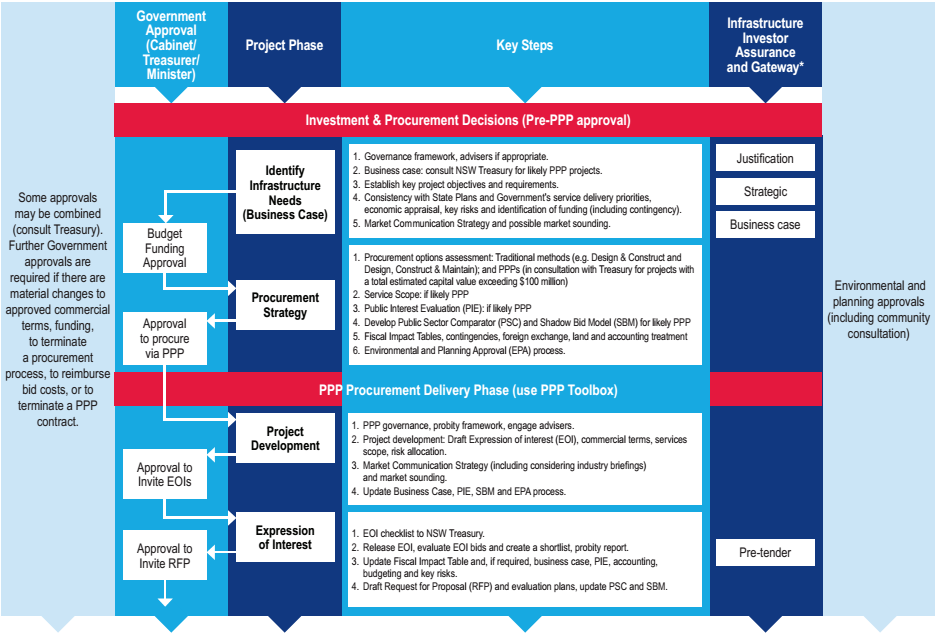
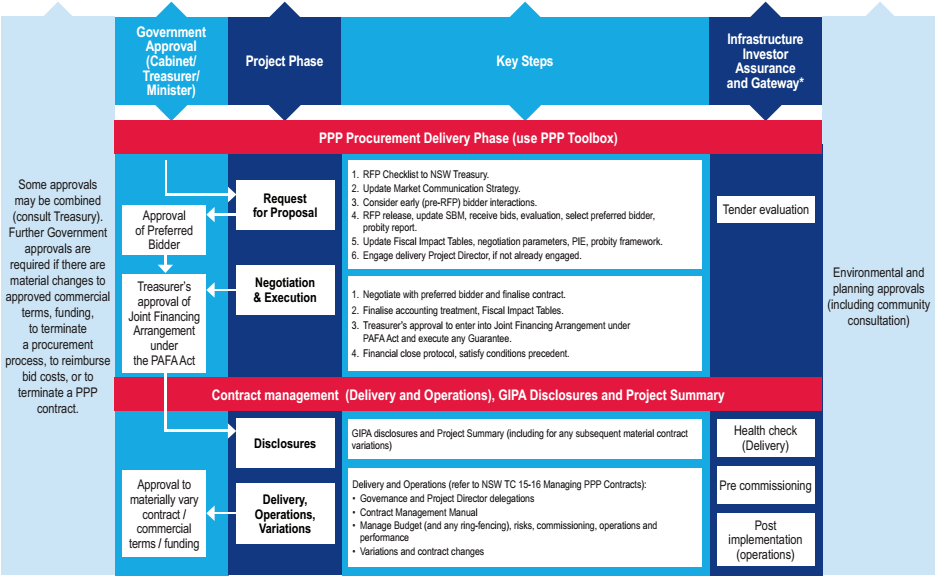
* Note a Gateway Health Check can occur at any time
__________________________________________________________________________________________
5 Detailed documentation requirements at each decision point are provided in chapters 4, 5 and 6 of these Guidelines, and in the more detailed National PPP Guidelines.