Geographic Coverage
Procuring Infrastructure PPPs 2018 covers 135 economies. In addition to the 82 countries assessed during Benchmarking PPP Procurement 2017, this year's edition includes all emerging markets and developing economies that have had at least one infrastructure PPP project in the last five years. In addition, 18 OECD (Organization for Economic Cooperation and Development) high-income economies were included to have a better representation worldwide. The 135 economies cover seven World Bank Group regions: 15 in East Asia and Pacific (EAP); 21 in Europe and Central Asia (ECA); 18 in Latin America and the Caribbean (LAC); 12 in Middle East and Africa (MENA); 6 in South Asia (SAR); 34 in Sub-Saharan Africa (SSA); and 29 in OECD high-income economies (Figure 1).
Figure 1 Economies covered in Procuring Infrastructure PPPs 2018
|
|
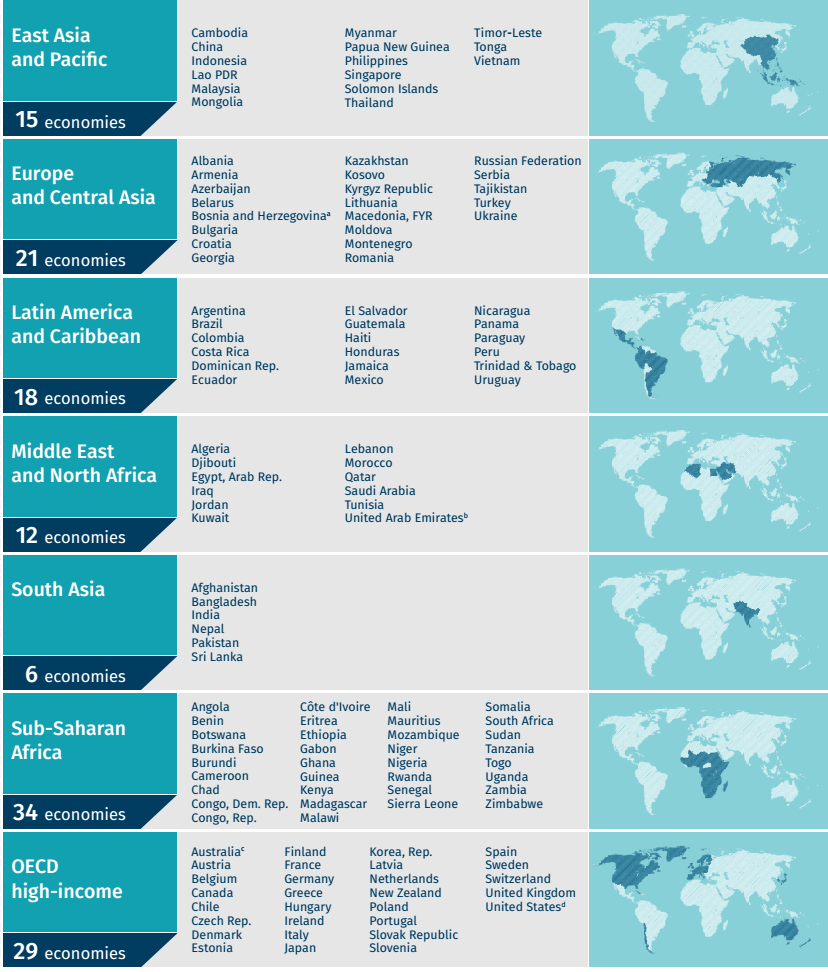
a. Sarajevo Canton | b. Emirate of Dubai | c. State of New South Wales | d. Commonwealth of Virginia
Note: Procuring Infrastructure PPPs 2018 uses the World Bank Group regional and income group classifications, available at http://data.worldbank.org/about/country-and-lending-groups. Regional averages presented in figures and tables in the Procuring Infrastructure PPPs 2018 report include economies from all income groups (low, lower-middle, upper-middle, and high-income), though high-income OECD economies are assigned the "regional" classification OECD high-income. The scope of the assessment is limited to infrastructure projects developed by procuring authorities at the national or federal level. However, in the cases of Australia, Bosnia and Herzegovina, United Arab Emirates, and the United States, the focus is on subnational units (the State of New South Wales, the Sarajevo Canton within the Federation of Bosnia and Herzegovina, the Emirate of Dubai, and the Commonwealth of Virginia, respectively). PPP = public-private partnership.