Procurement of PPPs

Once the preparation phase is completed and a decision is made to deliver an infrastructure project as a PPP, the procuring authorities will proceed with the procurement phase. The private partner is usually selected through a public tendering process, with the application of either the general public procurement rules or rules especially tailored for PPP procurement. The long-term success of a PPP depends to a large degree on the choice of the best-suited private partner. Whether the government achieves the target value for money through the PPP is conditioned upon the private partner's capacity for innovation and for achieving efficiency gains. The importance of selecting the right private sector partner is increased by the long-lasting nature of PPP projects and the magnitude and extent of public resources at stake. By choosing the correct private partner, the government can increase the likelihood of creating a trusting relationship and of attaining the outcomes promised by PPP projects. Thus, bidder qualifications and proposals must usually be evaluated thoroughly to ensure the delivery of expected value for money.
Most PPP procurements take more time and are more complex than conventional procurement. The transaction costs for both the public and the private sector partners naturally increase due to these longer and more complicated tendering procedures, which may deter competition. Procuring authorities should take this into account when deciding to use the PPP option. Minimizing the transaction costs should therefore be one of the basic elements to ensure equal treatment of all bidders, alongside the clarity, fairness, and transparency of the procurement process to achieve value for money.
The thematic coverage of procurement by Procuring Infrastructure PPPs 2018 was conceived to be broad enough to encompass varied aspects of the procurement process, such as bidders' access to procurement-related information, the clarity and comprehensiveness of the procurement documents, the qualification of bid evaluation committee members, the bid selection criteria used, the way governments deal with cases of sole proposals, and the restriction on negotiation during the award phase. The recognized good practices that could be drawn from the areas covered by Procuring Infrastructure PPPs 2018 in the procurement of PPP projects are summarized in Box 4.
| Box 4 The procurement of PPPs: Good practices scored in Procuring Infrastructure PPPs 2018 Good practices that help ensure fair competition, value for money, and transparency during the PPP procurement process include the following: › The bid evaluation committee members meet minimum technical qualifications. › The procuring authority publishes the public procurement notice online. › The procuring authority grants at least 30 calendars days to potential bidders to submit their proposals. › Foreign companies are not prohibited from participating in PPP procurement processes. › The procuring authority can choose among a range of competitive procedures based on their suitability. › The tender documents explain in detail the procurement procedure providing the same information to all bidders. › The tender documents specify any prequalification/shortlisting criteria, if applicable. › Potential bidders can submit questions to clarify the public procurement notice and/ or the request for proposals and the answers are disclosed to all potential bidders. › The procuring authority conducts a pre-bid conference to further inform potential bidders and the clarifications provided are disclosed to all potential bidders. › Bidders prepare and submits a financial model with their proposal. › The procuring authority evaluates the proposals strictly and solely in accordance with the evaluation criteria stated in the tender documents. › The procuring authority follows a specific procedure to guarantee value for money if only one proposal is submitted. › The procuring authority publishes the award notice online. › The procuring authority provides all bidders with the results of the PPP procurement process, including the grounds for the selection of the winning proposal. › There is a standstill (or pause) period after the intent to award the contract has been shared with the bidders and before the contract is awarded to allow unsuccessful bidders to challenge the award decision, and this period is specified in the RFP documents and intent to award notice. › Any negotiations between the selected bidder and the procuring authority after the award and before the signature of the PPP contract are restricted and regulated to ensure transparency. › The procuring authority publishes the signed PPP contract and its amendments online. |
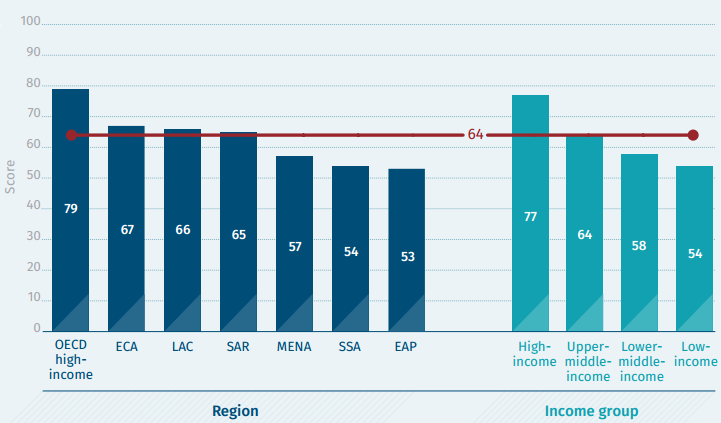
The Procuring Infrastructure PPPs 2018 data reveal regional and income group differences in the average score for PPP procurement (Figure 8). The OECD high-income region leads in the scoring, followed by Europe and Central Asia, Latin America and the Caribbean, and South Asia. There is a prominent discrepancy between the performance of the best performing region (79 points) and the worst one (53 points). The East Asia and Pacific region not only has the lowest average score, but it also has the greatest intraregional variance by far, with scores ranging from 7 points to 82 points. When disaggregated by income level, the data reveal the following trend: the lower the income level of a country, the lower its the scores on PPP procurement.
Figure 8 PPP procurement, score by region and income group (score 1-100)
Source: Procuring Infrastructure Public-Private Partnerships 2018.
Note: ECA = Europe and Central Asia; EAP = East Asia and Pacific; LAC = Latin America and the Caribbean; MENA = Middle East and North Africa; PPP = public-private partnership; OECD = Organization for Economic Co-operation and Development; SAR = South Asia; SSA = Sub-Saharan Africa.
The analysis that follows focuses on the transparency of the PPP procurement process, including scrutinizing the interactions between the procuring authority and the private sector partner, the disclosure of the PPP procurement process results, and the standstill period.