Interactions between the Procuring Authority and Bidders
During the procurement process, the government needs to define how and to what extent it will interact with bidders as they prepare their proposals. In order to safeguard transparency and fairness, rules governing the process and permissible topics for interaction with bidders should be specified in the tender documents. Such interaction typically involves providing information to the bidders and responding in writing to requests for clarification on the request for proposal (RFP) documents. Pre-tendering communications between bidders and the procuring authority are usually done either through pre-bid conferences26 or through bidders' inquiry in writing. In the former case, the procuring authority will present the project and respond to questions from bidders and issue the written minutes of meeting and response to the queries to all bidders that have been/will be issued the RFP documents, whereas in the latter, bidders submit questions related to the public procurement notice as well as the RFP documents and the procuring authority issues clarifications in writing to all the parties that have been issued the RFP documents or will be issued the RFP documents, without identifying the source of the query.27 These interactions may result in modifications to the tender documents. Consequently, the best practice is to make all questions seeking clarification and the corresponding answers available to all bidders to ensure equal access to information and fairness. This helps potential bidders better understand and meet the needs of the procurement authority, and fully grasp the responsibilities they are expected to fulfill.
Only 4 percent of the economies, in their regulatory frameworks, do not provide bidders with the opportunity to raise questions to clarify the content of the bidding documents during the pre-tendering phase. Economies such as Algeria, the Republic of Congo, Papua New Guinea, and Thailand do not sufficiently regulate interaction between the bidder and the procurement authority, potentially jeopardizing the preparation of solid bids.
Forty percent of the economies allow bidders to submit clarification questions only in writing, including Afghanistan, Bosnia and Herzegovina, Bulgaria, Lebanon, and Myanmar. This system provides an intermediate level of interaction between the procurement authority and the potential private partner. On the other end of the spectrum, 55 percent of economies have regulatory frameworks that not only allow bidders to submit clarification questions, but also enable the procuring authority to conduct pre-bid conferences. Having the procuring authority present the project and answer bidders' questions during pre-bid conferences, in addition to responding to clarification questions about the tender notice and RFP documents, gives bidders the highest level of clarity about the project. Economies where such best practice is followed include Australia, Belgium, Mexico, and Saudi Arabia.
Disparities in information between the parties in a procurement process may lead to opportunistic behavior. To help guarantee fairness for all bidders, the questions, related clarifications, and resulting modifications must be communicated by the procuring authority to all the bidders in writing, without identifying the source of such queries/clarifications. Disclosure of information to all bidders ensures transparency and fairness, which enhances competition and helps achieve better value for money. While confidential information pertaining to the bidders needs to be protected, notification of the clarification questions and the answers to such questions would help bidders better understand the project's requirements. A transparent process could allow bidders to prepare more sustainable proposals, which would ultimately result in a contract with a better chance of success and improved delivery.
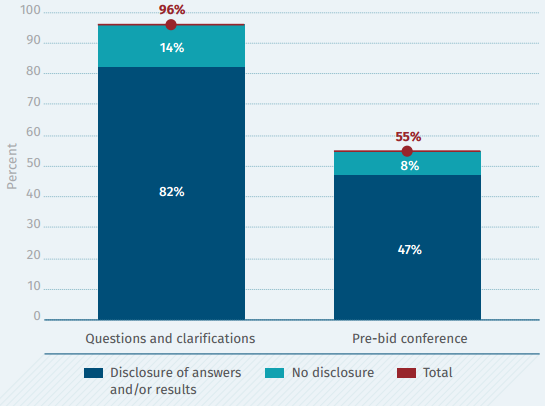
As shown in Figure 9, nearly all the economies (96 percent) allow clarification questions to be submitted, and in 82 percent, the procuring authority discloses the outcomes to all bidders. However, in a minority of economies, such as Benin, Cambodia, Iraq, Mongolia, Sudan, and Zambia, authorities are not required to disclose the clarification questions submitted, or the answers to the bidders.
When the procuring authority convenes a pre-bid conference, it is good practice to prepare minutes of meetings containing the requests for clarification of the RFP as well as the responses to those requests. In order to maximize transparency, copies of the minutes should be sent to all the prospective bidders and appended to the RFP documents to be issued to those new set of prospective bidders who obtain such RFP documents after the pre-bid conference. As mentioned, more than half (55 percent) of economies allow pre-bid conferences, and almost half (47 percent) disclose the information provided at these conferences. In a few cases, disclosure of clarifications resulting from the pre-bid conferences is not required, including Japan, Kazakhstan, Mali, Mongolia, and Solomon Islands.
Figure 9 Access to information during PPP procurement (percent, N=135)
Source: Procuring Infrastructure Public-Private Partnerships 2018.