PPP Contract Management

Adequate preparation and procurement are only the first steps on the road to the success of the long-term commitment of a PPP project. Once the PPP contract is signed and financial close is reached, the implementation of the project begins. The success of project implementation will determine whether the project delivers the expected value for money. Therefore, it is crucial to establish a sound PPP contract management system to oversee the implementation of the PPP contract.
Given the long-term nature of PPPs, the contracts should be drafted in a way that addresses any circumstances conceivable at the time of closing, allowing for the resolution of any issues that may arise later, according to the provisions of the contract. However, because not all circumstances are clearly foreseeable by their nature, it may not be feasible to attempt regulating every single potential issue in the PPP contract. Unexpected circumstances should be addressed by means of contract management mechanisms premised on a level of diligence tailored to specific needs and properly regulated renegotiation frameworks clearly defining the grounds and mechanism of such renegotiations. Also, for the purposes of transparency and to provide the parties with grounds for legitimate expectations, it is crucial for methods of dispute resolution to be specified, along with the detailed effects of project termination.
Procuring Infrastructure PPPs 2018 recognizes the importance of the contract management stage and measures aspects such as the extent to which regulatory frameworks and generally followed practices provide sufficient oversight mechanisms; a framework to manage changes to the structure of the private partner; renegotiations of the PPP agreement; modes of dispute resolution; as well as contract features such as lenders' step-in rights31 and termination of the contract and its consequences. Recognized good practices applicable during PPP contract management are summarized in Box 6.
Box 6 PPP contract management: Good practices scored in Procuring Infrastructure PPPs 2018 Good practices to ensure a successful implementation and delivery of the PPP project include the following: › The procuring authority has a system to manage the implementation of the PPP contract, including establishing a PPP contract management team; involving some contracts management team members in the project starting at the procurement stage; and adopting PPP implementation manuals and risk mitigation mechanisms. › The procuring authority establishes a system for tracking progress and completing construction works under a PPP contract, with relevant information made publicly available. › Monitoring and evaluation systems are in place to oversee the implementation of the PPP contract after the construction stage, with relevant information publicly available. › Foreign companies are not prohibited from repatriating the income generated by the operation of a PPP project. › Potential changes in the structure of the private partner are expressly regulated, requiring the replacing entity to be at least as qualified as the original private partner. › Modification and renegotiation of the contract are expressly regulated to reduce incentives to use these changes opportunistically by either the private partner or the procuring authority. › Specific circumstances (force majeure, material adverse government action, change in the law, refinancing) that may arise during the life of the contract are expressly regulated. › Dispute resolution mechanisms are in place allowing the parties to resolve disputes in an efficient and satisfactory manner without adversely affecting the project. › Lenders are given step-in rights for cases when the private partner is at risk of default or if the PPP contract is under threat of termination for failure to meet service obligations. › Grounds for termination of the PPP contract and its associated consequences are well defined. |
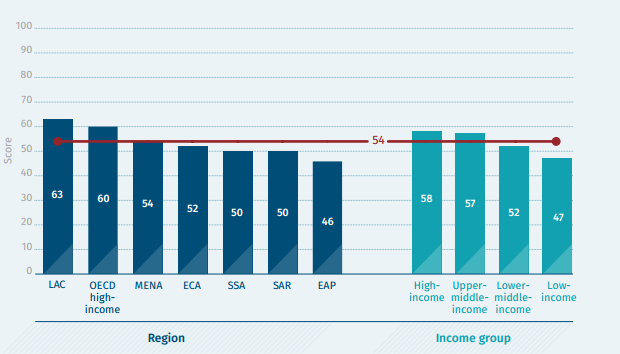
The Procuring Infrastructure PPPs 2018 data reveal regional and income group differences in the average score for PPP contract management (Figure 14). The Latin American and Caribbean region has the highest score, followed by the OECD high-income region. Intraregional variance is high in all regions in this thematic area. For example, scores within the East Asia and Pacific region are as low as 9 points and as high as 88 points. In contrast, there is little variation across regions. The average for the leading the region (Latin America and the Caribbean) (63) is only 17 points ahead of the worst-performing region (East Asia and Pacific). When the data are disaggregated by income level, there is a clear pattern showing that the lower the income group level, the lower the average scores.
Figure 14 PPP contract management, score by region and income group (score 1-100)
Source: Procuring Infrastructure Public-Private Partnerships 2018.
Note: ECA = Europe and Central Asia; EAP = East Asia and Pacific; LAC = Latin America and the Caribbean; MENA = Middle East and North Africa; PPP = public-private partnership; OECD = Organisation for Economic Co-operation and Development; SAR = South Asia; SSA = Sub-Saharan Africa.
The next section focuses on renegotiation and termination of PPP contracts as key components that must be regulated for projects to be able to deliver their desired outcomes and uphold value for money.