Termination of PPP Contracts
PPPs come to their regular end when the works are performed in a satisfactory manner and the contract's pre-agreed duration expires. Nevertheless, early termination of the contract can also be an option under some circumstances, including when contractual obligations are not being met by one or both parties and circumstances where neither party is at fault.44 Grounds for termination in instances of premature and unilateral termination, as well as their consequences, should be specifically identified and set out in the contract. Early termination should be the last resort because it is costly.45 With the exception of 16 economies (12 percent of the total, including Angola, Myanmar, and Nigeria), termination of PPP contracts is addressed in the regulatory framework across all assessed economies.46
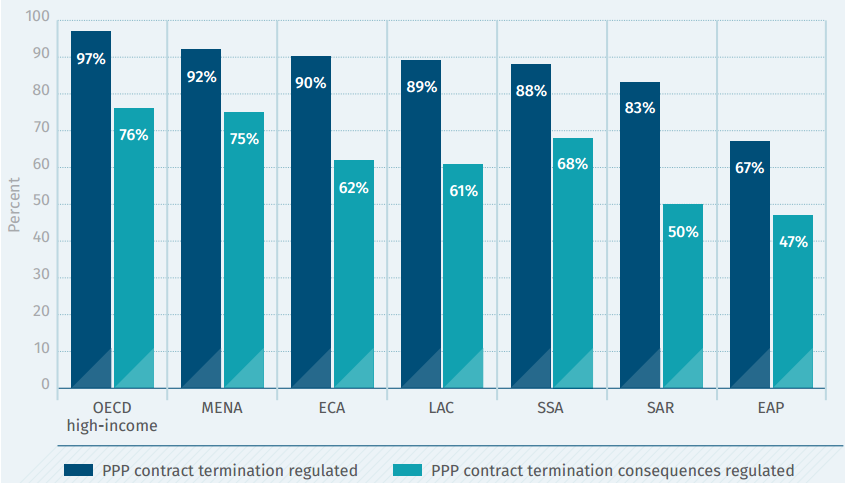
The majority of economies (65 percent) not only address the grounds for termination in their regulatory frameworks, but also its consequences, as is the case in in Albania, Kyrgyz Republic, Mauritius, Montenegro, Paraguay, and Romania. Economies that do not further regulate these consequences include Belarus, Ecuador, Lao PDR, and Qatar. OECD high-income economies have the highest number of economies that regulate both grounds for the termination of the PPP contract and its consequences, while the East Asia and Pacific region has the lowest number of economies that regulate both issues (Figure 18).
Figure 18 Regulation of PPP contract termination and its consequences, by region (percent, N = 135)
Source: Procuring Infrastructure Public-Private Partnership 2018
Note: OECD = Organization for Economic Co-operation and Development; ECA = Europe and Central Asia; LAC = Latin America and the Caribbean; SSA = Sub-Saharan Africa; MENA = Middle East and North Africa; EAP = East Asia and Pacific; SAR = South Asia.
In some economies, the PPP agreement is the instrument used to regulate the circumstances for termination and their consequences. This is the case in Argentina, where the law defers to the PPP agreement to regulate the circumstances for termination and its consequences, and outlines only general aspects to be included in such an agreement. Azerbaijan, however, defers to the PPP contract to regulate all aspects of grounds for termination while making no mention of its consequences.47
When the issue of termination is of a contractual nature, specific standard contracts may exist to help guide contracting parties. Standard contracts set minimum standards that must be included in the different PPP agreements. Of the 24 economies that clearly defer to the parties of the PPP agreement to regulate termination in the contract, only 25 percent make available standardized contracts to help guide parties while drafting termination clauses. In New Zealand, the Standard Form Public Private Partnership (PPP) Project Agreement specifies grounds for and consequences of termination, whether for purposes related to the public entity or private entity, or if neither party's at fault.48 The Indian Model Concession Agreement adopts a similar approach and further sets thresholds for compensation payments in cases of termination.49
Different circumstances permit PPP contracts to be terminated, and they are usually addressed by economies that specifically regulate termination. These enabling conditions can range from non-fulfillment of obligations by the private partner to the public entity's consistent default in meeting its payment obligations. Other circumstances may not be associated with either party, such as force majeure, but should be addressed. In addition, public order or interest is an often-cited ground for unilateral termination on the part of the public entity. This is the case in economies like Colombia, Gabon, Iraq, Kazakhstan, Mauritius, Niger, and Senegal. However, frequent exercise of such unilateral termination powers may weaken private investors' confidence in the PPP market.50 Outlining the grounds for termination, as well as their outcomes, in detail in advance boosts the level of trust and reduces uncertainty for PPP project's stakeholders, decreasing risk premiums and providing greater value for money.51
Once a contract has been terminated, either on schedule or prematurely, many consequences emerge, such as the requirement to provide monetary compensation or project site handover. The identification of such consequences in the contract ensures, among other things, that the private partner is not put in a disproportionately disadvantaged situation should the public entity decide to end the contract. Moreover, it safeguards the continuation of services to the public in the event of termination. Termination consequences in many economies include transfer of technology, buildings, and equipment; compensation for the fair value of works; and service continuity. This is the case in Benin52 and Burkina Faso, which even regulates training for the public authority staff in case of early termination.53 Some economies address compensation in greater detail. In Italy,54 Paraguay, the Philippines, and Uruguay, compensation calculations for termination are embodied in their regulations. In Colombia, a mathematical formula is established to determine any reciprocal benefits between the parties as a result of the PPP contract's early termination either by mutual agreement or unilaterally.55