Unsolicited Proposals

Unsolicited proposals (USPs) are an alternative to government-initiated infrastructure projects. Instead of the government first identifying and assessing the need and suitability of an infrastructure project as a public-private partnership (PPP), a private sector entity approaches the government with a proposal to develop a specific infrastructure project. USPs have been increasingly used in recent years. According to the World Bank Group's Private Participation in Infrastructure (PPI) Database,56 approximately 4 percent of infrastructure projects within the economies covered by the Procuring Infrastructure PPPs 2018 project in low- and middle-income economies are started at the initiative of a private sector entity without an explicit request from a government to do so. Private sector companies, generally developers, suppliers, and/or financiers, finance the studies to establish basic project specifications and then approach the relevant government entity for approval.
Given the nature of USPs, their increasing use as an alternative procurement method comes with considerable concerns for public infrastructure practitioners. Whereas in theory, the use of USPs will allow governments to benefit from the knowledge and innovation of the private sector, USPs can introduce several challenges, such as diverting public resources away from governments' strategic plans and priorities, failing to attract competition, and ultimately leading to opportunities for corruption.57 With the private sector playing a more prominent role in delivering the billions of dollars in investment needed in infrastructure, a balance needs to be found between allowing the private sector to propose viable and necessary infrastructure projects and the need for those projects to be in the public interest and achieve the best value for money.
To ensure that the potential benefit of USPs is harnessed while the risks associated with them are minimized, governments should follow an established set of good practices. First, governments need to determine whether they will accept USPs as part of their PPP programs. If they decide that USPs shall be employed, it is imperative for governments to set and specify key objectives for USP programs. The responsible government authority should assess the merits of the submitted USP: whether there is demand for the proposed project, whether the project is aligned with national infrastructure priorities and meets a real societal and economic need, and whether the USP is not already a part of a government PPP pipeline.58 Then, if the USP is justified, the government should initiate a transparent and competitive procurement procedure to select between the USP proponent and other bidders, to ensure achieving the best value for money. A list of good practices concerning USPs is presented in Box 8.
| Box 8 Unsolicited proposals of PPPs: Good practices scored in Procuring Infrastructure PPPs 2018 Good practices to ensure transparency and competition during the procurement of projects originated as USP include the following: › The procuring authority assesses the merits of the USP and ensures that it is aligned with the government's investment priorities. › There is a vetting procedure and/or a pre-feasibility analysis before moving forward and fully assessing the unsolicited proposal. › If the USP is justified, the procuring authority initiates a competitive procurement procedure to select the private partner. › The procuring authority grants at least 90 days to all potential bidders (besides the proponent) to submit their proposals. |
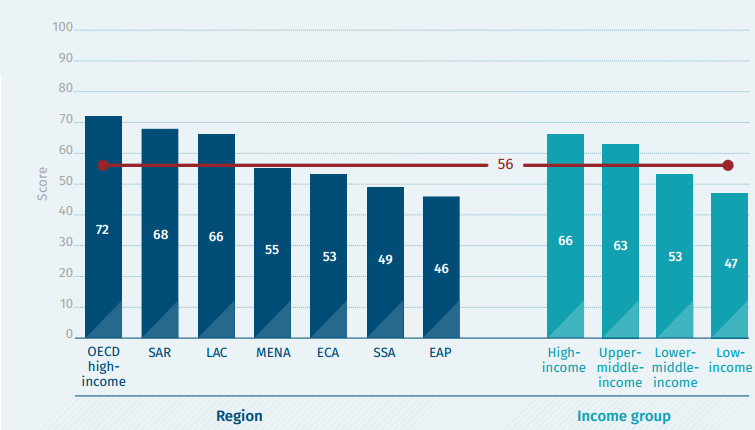
The Procuring Infrastructure PPPs 2018 data reveal regional and income group differences in the average score for USPs (Figure 19). The OECD high-income, South Asia, and Latin American and Caribbean regions stand out from the rest of the regions. East Asia and Pacific has the lowest average score, whereas the Latin America and Caribbean region has the highest variation in scores among economies within the region, ranging from as low as 13 to as high as 100. Disaggregating the data by income level reveals a clear pattern: the higher the income group level, the higher the average scores on USPs.
Figure 19 USPs, score by region and income group (score 1-100)
Source: Procuring Infrastructure Public-Private Partnerships 2018.
Note: ECA = Europe and Central Asia; EAP = East Asia and Pacific; LAC = Latin America and the Caribbean; MENA = Middle East and North Africa; PPP = public-private partnership; OECD = Organization for Economic Co-operation and Development; SAR = South Asia; SSA = Sub-Saharan Africa.
While the scope of Procuring Infrastructure PPPs 2018 encompasses a wide array of data related to USPs, including USP evaluation by public authorities and mechanisms for compensating the original proponent, this section focuses on two areas of importance. First, it provides an analysis of the different regulatory frameworks that govern USPs. Second, it considers the bidding procedures for USPs and the minimum time limits for potential bidders to prepare and submit their bids.