RECOMMENDED TREATMENT PLAN
The required treatment plan and recommendations need to reflect that the construction industry is chronically underinvested due to a combination of economic, market and behavioural factors. It requires a wholesale and coordinated 'special measures' approach to drive transformational change that at the heart of any recommendations needs aligned stakeholder intent, sufficient funding and ultimately, scale.
Critically, a plan for change needs to recognise, based on past evidence, that the industry will not change itself unilaterally at scale. It needs to be led by clients expressly changing their needs and commissioning behaviours or government acting in a regulatory or strategic initiation capacity to drive positive disruption.
Any such disruption needs to be appropriately structured, with strong leadership so that it affects the market in key areas that will have the greatest and quickest impact and is ultimately supported by a sound business case; not just optimistic ambitions, target setting or aspirational statements of intent.
At the heart of this review's recommendations, and on the basis of the defining principles set out above, it is proposed that a new, ambitious and mutually beneficial tripartite covenant is established between the construction industry, its end clients (private and public) and government acting as a strategic initiator.
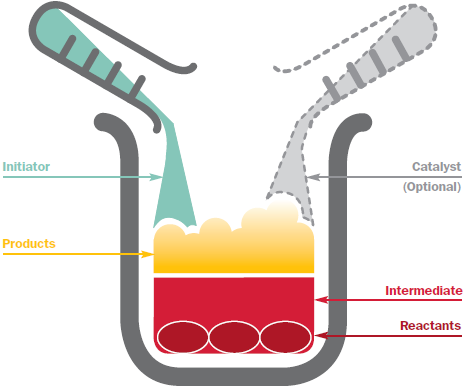
With an ultimate goal of creating long- term transformational change across such a complex and multi-faceted entity as the construction industry, it may be useful here to compare the component parts of the recommendations to the basic ingredients for creating a chemical 'chain reaction'. The 5 key components that would usually be necessary and their analogies for this review are:
|
| Reactants - the key elements necessary to be part of the reaction - Integrated Tripartite Leadership across Clients, Government and Industry |
|
| Intermediate - the enabler of a reaction - A Reformed CITB |
|
| Products - the desired outcomes that arise from the reaction and which also self-perpetuate the reaction - Client & Industry Process Integration, R&D & Innovation, Skills & Training, Industry Image |
|
| Initiator - the means by which a reaction is commenced - The Role of Government in Pump Priming Change |
|
| Catalyst - a mechanism to accelerate or speed up a reaction - An Option for Accelerating Behavioural Change |


The headline recommendations of this review are as follows:
|
| Recommendation 1: The Construction Leadership Council (CLC) should have strategic oversight of the implementation of these recommendations and evolve itself appropriately to coordinate and drive the process of delivering the required industry change programme set out in this review. |
|
| Recommendation 2: The Construction Industry Training Board (CITB) should be comprehensively reviewed and a reform programme instituted. |
|
| Recommendation 3: Industry, clients and government should work together leveraging CLC's Business Models workstream activity, to improve relationships and increase levels of investment in R&D and innovation in construction by changing commissioning trends from traditional to pre-manufactured approaches. The housing sector (spanning all tenures) should be used as a scalable pilot programme for this more integrated approach. |
|
| Recommendation 4: Industry, government and clients, supported by academic expertise and leveraging CLC's current Innovation workstream activity, should organise to deliver a comprehensive innovation programme. This should be fully aligned to market, benefits case led and generate a new shape of demand across industry (with a priority on residential construction). It should quickly define key measures of progress and report regularly against these as a check on the possible need for more radical measures. It should, in turn, also help to shape CITB reform proposals in relation to technology and innovation grant funding initiatives. |
|
| Recommendation 5: A reformed CITB should look to reorganise its grant funding model for skills and training aligned to what a future modernised industry will need. Industry bodies and professional institutions should also take a more active role in ensuring that training courses are producing talent which is appropriate for a digitally enabled world, making sure that the right business models are evolved with appropriate contractual frameworks. |
|
| Recommendation 6: A reformed CITB or stand-alone body should be challenged and empowered to deliver a more powerful public facing story and image for the holistic 'built environment' process, of which construction forms part. This responsibility should include an outreach programme to schools and should draw on existing industry exemplars and the vision for the industry's future state rather than just 'business as usual'. |
|
| Recommendation 7: Government has recently reaffirmed its commitment to having a strong industrial strategy. The Government should recognise the value of the construction sector and be willing to intervene by way of appropriate further education, planning and tax / employment policies to help establish and maintain appropriate skills capacity. |
|
| Recommendation 8: Government should act to provide an 'initiation' stimulus to innovation in the housing sector by promoting the use of pre-manufactured solutions through policy measures. This should be prioritised either through the conditional incentivisation of institutional development and investment in the private rented sector; the promotion of more pre-manufactured social housebuilding through Registered Providers; direct commissioning of pre-manufactured housing; or a combination of any of the above. It should also consider planning breaks for pre-manufactured approaches. |
|
| Recommendation 9: Government, as part of its housing policy planning, should work with industry to assemble and publish a comprehensive pipeline of demand in the new-build housing sector. This should be along the same lines as the National Infrastructure Pipeline, seeking to bring private developers and investors into this as far as possible to assist with longer term innovation and skills investment planning. |
|
| Recommendation 10: In the medium to longer-term, and in particular if a voluntary approach does not achieve the step-change necessary, government should consider introducing a charge on business clients of the construction industry to further influence commissioning behaviour and to supplement funding for skills and innovation at a level commensurate with the size of the industry. If such a charge is introduced, it should be set at no more than 0.5% of construction value, with a clear implementation timetable. Clients should be able to avoid paying this by demonstrating how they are contributing to industry capacity building and modernisation by directly or indirectly supporting skills development, pre-manufacturing facilities, or other forms of innovation and R&D. |


