Low Productivity

| "...poor productivity growth in construction is not just a UK phenomenon..." |
One of the critical features of the industry is its extremely poor level of productivity. When assessed against other industries, especially manufacturing led ones, the differential is stark, not only in current absolute terms but also in how the gap has widened over time. Other industries have harnessed wholesale process improvement by embracing and commercialising the role of technology and have effectively reinvented themselves by driving a paradigm shift in their end-to-end delivery. In 2005 Professor Michael Ball published a report entitled 'The Labour Needs of Extra Housing Output'2 that highlighted house building's inability to achieve the significant annual productivity gains that are seen in some other industries. This can also be said to apply to the wider construction industry beyond house building. There has been little change in the situation in the last decade. The UK industry is by no means alone in this issue. The recent World Economic Forum Report 'Shaping the Future of Construction'3 shows a 19% fall in productivity in US construction since 1964 whilst all other non-agricultural industries have, by contrast, shown a 153% improvement in the same period (see Figure 1).
A similar position of no significant change in productivity is evident in Figure 2 showing productivity change across Europe from the recent report from The Chartered Institute of Building (CIOB) 'Productivity in Construction'.4 This stated that "...poor productivity growth in construction is not just a UK phenomenon..." in part reflecting the difficulty in measuring productivity in construction but also alluding to something much deeper about generic industry characteristics that set the scale of the challenge to improve.
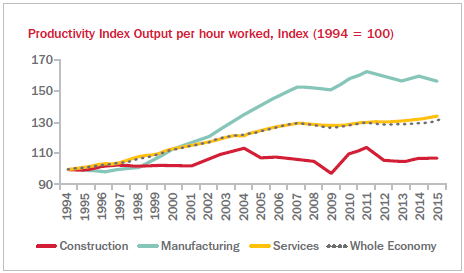
Figure 3 also shows UK productivity growth since 1994 by industry. Productivity in construction has been essentially flat in that period, in contrast with other industries, particularly manufacturing, where output per hour worked in 2015 was over 50% greater than 1994 levels.
The upturns of UK productivity in construction that can be seen in Figure 2 and 3 tend to coincide with economic slowdowns. This indicates that in high output periods, less productive workers enter the industry and dilute overall productivity. This is noticeable in construction due to labour still being the dominant determinant of overall unit productivity; whereas in other industries, automation effectiveness is much more significant.
Numerous failures account for the industry's poor productivity, including fragmented transactional and risk transfer interfaces, lack of early well-defined client briefs, a propensity for clients to change their requirements late in the process, design - procurement - construction process separation, and large scale industry re-working and defects rectification. The BIS report 'Supply Chain Analysis into the Construction Industry'5 argued that construction can accommodate change too readily and at too low a cost at the point of the change. Although there is a peripheral awareness of 'Lean' and other optimisation techniques used in other industries, there is no mainstream shift towards embracing such thinking as a catalyst for process and productivity improvement. There are however some interesting exceptions that appear to be driven by clients of the construction industry whose core business lies in more advanced sectors such as manufacturing, pharmaceuticals or defence (see Case Study 1).
Figure 1: From Shaping the Future of Construction: A Breakthrough in Mindset and Technology, World Economic Forum in collaboration with the Boston Consulting Group, 4 May 2016.
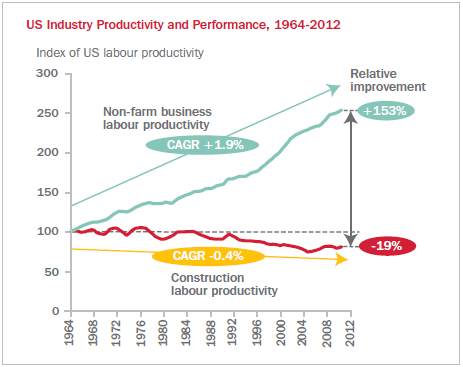
Figure 2: OECD Productivity and ULC by main economic activity (ISIC Rev.4) data, 2015
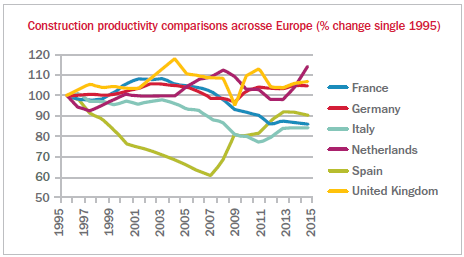
Figure 3: ONS Labour Productivity, Q4 2015. Table 1 and 8. April 2016.
____________________________________________________________________________________________
2 Professor Michael Ball, The Labour Needs of Extra Housing Output: Can the housebuilding industry cope? CITB and HBF, 2 December 2005.
3 Shaping the Future of Construction: A Breakthrough in Mindset and Technology, World Economic Forum in collaboration with the Boston Consulting Group, 4 May 2016.
4 Brian Green, Productivity in Construction: Creating a Framework for the Industry to Thrive, The Chartered Institute of Building (CIOB), 24 May 2016.
5 BIS Research paper no.145, Supply Chain Analysis into the Construction Industry: A Report for the Construction Industry Strategy, October 2013.