CASE STUDY 1 GSK "FACTORY IN A Box"
Pharmaceuticals multinational GSK's 'Factory in A Box' is a building packaged as a repeatable commodity. The boxes are in fact shipping containers that contain every component packed in the reverse order needed for the re-assembly process.
The project responded primarily to GSK's need to develop factories and packaging facilities in emerging markets, particularly in Africa and Asia, that would meet very high internal compliance standards without spiralling costs. The hypothesis was to fit all elements into a shipping container that could be sent anywhere to be built by anyone.
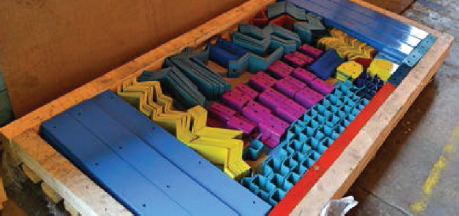
A crate of coloured brackets and fixing connections, which match to coloured stickers positioned on the components during the manufacturing process.
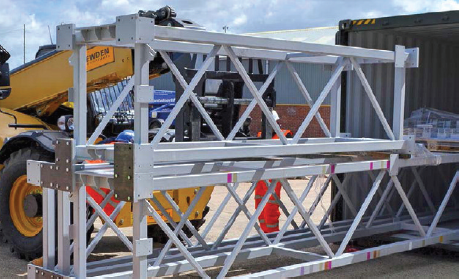
Case study sourced from Bryden Wood and article by Elaine Knutt, 'The Building Built by Gurkhas' in Construction Manager Magazine, 3 February 2016.
Developed for GSK by innovative design and management consultant Bryden Wood, the "Factory In A Box" cuts the construction programme from 12 weeks to four and delivers an estimated 30% saving compared to the same facility built conventionally.
Bryden Wood's approach was to standardise and commodify the design and construction process by breaking the problem down into 'chips', or groups of related components, described by Jaimie Johnston, Director at Bryden Wood, as "the Lego bricks of the process." Connecting the chips in a workable order delivers a schematic for a functioning production facility, meaning the GSK team can draw up a reliable cost estimate of a bespoke new facility within a matter of days - and then modify its capacity or layout equally quickly. The chips are based on standard GSK functions across its property portfolio, such as storage areas, clean rooms, blending chemicals or packaging.
The team break down the processes and create a database about each chip defining its physical characteristics, its energy requirements, air change requirements and how many operatives it will need and the training they require. The chips are both physical and digital entities containing all the related BIM object data, so that the actual building will be an exact representation of the digital model, with its components assembled in the same sequence.
Cataloguing repeatable components and systems in this way also means that components can be tagged with 2D bar codes and tracked through manufacturing distribution and on to site, generating accurate data on the actual cost and labour requirements.
GSK plan to introduce elements of the project into the company's construction programme in the UK to deliver greater cost certainty. Longer-term, the aspiration is evolve similar solutions that could be applied to the health, education and residential sectors, leading a process revolution in the UK construction industry.