Poor predictability

| "There appears to be a general acceptance of failure and underperformance both by industry itself but also begrudgingly by clients." |
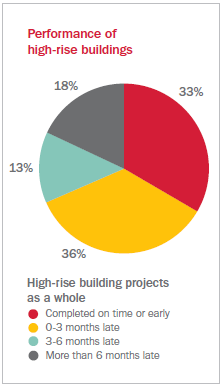
Alongside its productivity failings, the industry suffers a related inability to accurately deliver to plan. Success factors can be measured by different parameters but typically will relate to clients' core ambitions for time, cost and quality. Irrespective of whether the absolute standards being promised by industry in each of these categories are the best that they can be, the more concerning issue is that what is promised, regardless of how challenging, is often not delivered. The 2016 Scape Group survey 'Sustainability in the Supply Chain'6 found 58% of all supplier and contractor respondents had identified skills shortages as contributing to poor quality of workmanship. In addition 40% of private sector and 80% of public sector respondents to this survey attributed skills shortages to budget overspends. Failure incidence does also seem to correlate with building project technical complexity (difference in programme certainty between low and high rise buildings in Figures 4 and 5) which infers a basic inability to 'scale up' by coordinating and managing larger and more challenging tasks.
This lack of certainty has become an accepted norm in large parts of the industry and is often associated with its site based nature and the impact of 'unforeseen issues' such as unexpected ground conditions or poor weather. The reality is that the causes of failure are multi-faceted and often cannot be blamed on such issues. There appears to be a general acceptance of failure and underperformance both by industry itself but also begrudgingly by clients.
The true purpose of contingency and risk provisions within the industry have unfortunately been corrupted in many instances from being a pro-active business management tool to one of reactively masking preventable failures and poor planning. The exceptions are mostly in relation to more recent large infrastructure projects, where highly structured and robust approaches to project planning, combined with more integrated and long-term design and construction collaboration and incentivisation, have been driving different behaviours and less tolerance of underperformance. The higher risk profile and longer time periods associated with major infrastructure still makes low predictability an inherent feature of this sector of industry but irrespective, it would appear the wider construction sector does want to adopt the same levels of disciplined risk management that would promote better performance.
Figure 4: Managing the Risk of Delayed Completion in the 21st Century, Chartered Institute of Buildings, 2008
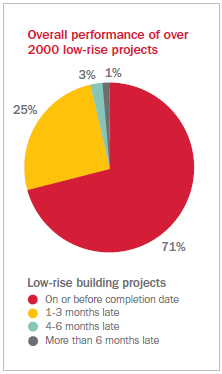
Figure 5: Managing the Risk of Delayed Completion in the 21st Century, Chartered Institute of Buildings, 2008
____________________________________________________________________________________________
6 Sustainability in the Supply Chain, The Scape Group, 22 August 2016.