CASE STUDY 4 PERSIMMON COMBAT TO CONSTRUCTION
The Combat to Construction Traineeship is a Persimmon Homes recruitment, training and employability programme which will enable male or female service personnel leaving the Armed Forces, at any level, to transfer their existing skills or gain a rewarding second career within the house building industry. Persimmon will train and employ service leavers and commit to pay them a living wage during their training, which will lead to a recognised qualification and above all, a fulfilling and rewarding career with the Company.
The skills and experience of many service leavers are highly comparable with those required to work within construction. The Combat to Construction Traineeship builds on those skills to help them start a rewarding new career with us. Just as in the Armed Forces, Trainees will be working as part of a highly professional team in which every member depends upon their colleagues to get the job done. Their military training will have given them the flexibility, discipline and loyalty to be adaptable and prepared to travel at short notice, allowing them to make a vital contribution, wherever the action is.

Persimmon Homes CEO Jeff Fairburn, Brigadier Bibby and ex-soldiers at the launch of Combat to Construction
The qualification is an NVQ Level 2 Framework in Trowel Occupation (Bricklaying) or Wood Occupation (Joinery) that can be achieved with hard work and commitment to qualify them into the industry. The training is free and they will receive a living wage to allow them to complete their qualification.
The programme starts with a 1 week block training period and assessment to ensure that Trainees will be able to complete the training to an acceptable level and so that Persimmon can quality-assure the Programme. There are no fees for the training.
On successful completion of initial training the trainee will be offered a contracted start date with Persimmon which will tie them into the company for a minimum of 3 years.
The pricing and payment of the CITB levy is often (but not always) seen more as a 'cost' than an 'investment'. It is often not overtly linked to what final clients of the industry pay and is 'lost' in the overall selling price. This appears to be different to commercial norms in the process engineering industry where, promoted by an emphasis on cost reimbursable contract forms, the Engineering Construction Industry Training Board (ECITB) levy seems to be recognised as an express part of what clients are paying. It is visible at the highest levels of the transaction chain rather than just being deemed to be part of a market set selling price to a client, standing the risk, as would appear to be the case with the CITB levy, of getting squeezed as an offset against margin when demand is weak.
At the time of writing this review, the impending Apprenticeship Levy is causing some concern in the industry. The imposition of a second levy in Spring 2017, set against a context of low margins and a mind-set of it being a cost not an investment is symptomatic of deep-seated inertia against increasing levels of investment in industry training when set against thin margins.
The reality is that notwithstanding the laudable principles of the levy, and even when factoring in how much industry pays in implementing training over and above the net cost of paying the CITB levy as well as the extra investment projected via the Apprenticeship Levy, the absolute levels of industry self-investment for training in construction are extremely low when viewed against other UK industry benchmarks.
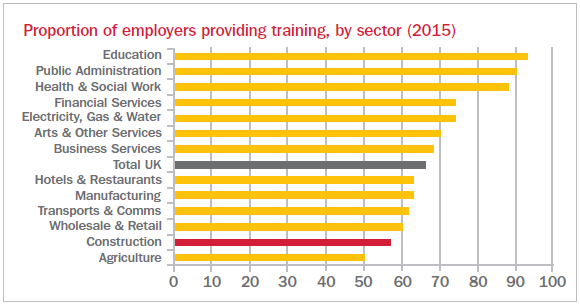
In 2015 UKCES15 research showed percentage of the workforce trained, when compared to other industries, is third lowest with only 53% of the workforce trained in 2015. The survey data also shows that only 57% of construction sector employers provided any training in 2015 - 2nd lowest of all sectors.
Figure 11: Employer Skills Survey: UK Results, UK Commission for Employment and Skills, 2015
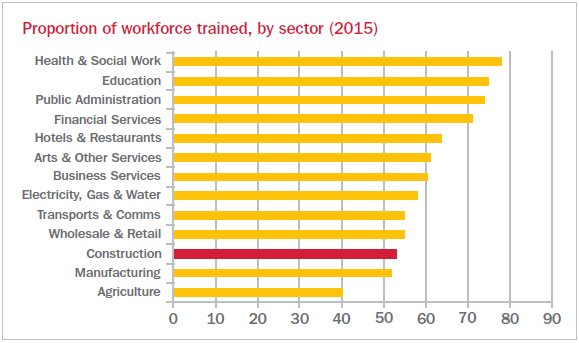
Figure 12: Employer Skills Survey: UK Results, UK Commission for Employment and Skills, 2015
£180million of CITB levy (with only £140m issued back in grants) in a £100 billion industry with 2.3million employees does not bode well in terms of ability to have any scalable impact.
As an example, housebuilders contributed £16million of levy in the last period and got grant back for £7million. This suggests either large scale lethargy in implementing training in this sub-sector (i.e. they accept the levy as a straight employment cost) or the smaller enterprise end of this sector are carrying out training without grant recovery which reduces margins and ability to invest in further initiatives and improvements. The larger volume housebuilders who are often recovering proportionally more are also to some degree delivering training in areas other than the capacity constrained core construction trades due to the simple fact that they no longer directly employ such tradesmen on their payroll.
____________________________________________________________________________________________
15 Sector Skills Insights: Construction Evidence Report 50, UK Commission for Employment and Skills (UKCES), July 2012.