4.1 Overall context of the utilization of PPPs in Africa
Africa has enjoyed more than a decade of rapid economic growth, especially Sub-Saharan Africa, with the continent producing nearly half or the twenty fastest-growing economies between 2011 and 2015. Building on this momentum will, however, require rapid infrastructure development. As much as US $93 billion will be required annually to meet Africa's infrastructure needs through to 2020, with only half of that amount currently being met, according to the African Development Bank. This infrastructure bottleneck threatens to slow the continent's progress, and effective models of infrastructure development are now essential to achieve sustainable growth. Public-private partnerships (PPPs) are emerging as a tool to achieving growth and bridging the infrastructure gap.
A growing body of international evidence points11 to the importance of an enabling and favorable regulatory environment and robust institutional framework in developing sustainable and efficient PPP infrastructure projects. By leveraging the strengths of both public and private actors, PPPs benefit from both the management and technical know-how of the private sector to deliver public services, and the public sector's abilities to guarantee the security of private investments and provide the legal and regulatory certainties that private investors need. Moreover, cash-strapped governments can take advantage of financing arrangements that the private sector can provide. When well designed, with proper cost recovery, appropriate risk allocation and investor protection, PPPs can drive essential infrastructure in a context of limited government budgets. The challenge is thus to ensure both strong rules and regulations, as well as effective implementation. PPP projects are difficult to execute and require robust regulatory and institutional architectures, high levels of technical capacity, political will and social consensus.
PPPs are on the agenda of African policymakers, with many countries passing new laws, policies and regulations to facilitate PPPs, particularly during the last six years. Although a unified PPP legal framework is lacking in some places, most African countries have adopted a national policy or have at least a PPP law in the pipeline12. According to the Economist's Unit (EIU) Infrascope13, most African governments14 are actively building PPP frameworks, with an uptick in new laws since 2009, but the implementation is lagging in ten out of 15 countries. Countries with PPP-specific legal frameworks in place are: South Africa, Kenya, Morocco, Egypt, Côte d'Ivoire, Tanzania, Tunisia, Cameroon, Nigeria and Zambia. There has been a particular uptick in new PPP-specific laws and policies over the last six years: Zambia (2009), Egypt and Tanzania (2010), Côte d'Ivoire (2012), Kenya (2013) and Morocco (2015). Of the remainder, three countries have PPP laws under policy development or moving through the parliamentary or presidential approval process (Rwanda since 2009, Ghana since 2013, Uganda since 2012). In two countries only, DRC and Angola, is there is no clear roadmap towards a PPP framework.
It is to be noticed that the Economist Intelligence Unit (EIU) Benchmarking Index is composed of six components: 1) country's legal and regulatory framework for private sector participation in infrastructure; 2) design and responsibilities of institutions that prepare, award, and oversee PPP projects; 3) government's ability to uphold laws and regulations for concession, as well as success rate and their success rate (operational maturity); 4) business, political and social environment for investment; 5) financial facilities for funding infrastructure; and 6) the quality of subnational framework and experiences in PPPs. Table 1 below presents the Index scoring and ranking of the fifteen (15) surveyed countries.
Table 1: Business Environment for Public-Private Partnerships in Africa
| Rank | Country | Overall Score | Judgement | ||
| 1 | South Africa | 70.7 | Mature | ||
| 2 | Morocco | 51.8 | Emerging | ||
| 3 | Kenya | 51.4 | Emerging | ||
| 4 | Egypt | 51.0 | Emerging | ||
| 5 | Tanzania | 48.6 | Emerging | ||
| 6 | Côte d'Ivoire | 45.5 | Emerging | ||
| 7 | Tunisia | 45.4 | Emerging | ||
| 8 | Uganda | 45.1 | Emerging | ||
| 9 | Rwanda | 43.5 | Emerging | ||
| 10 | Ghana | 43.0 | Emerging | ||
| 11 | Cameroon | 38.2 | Emerging | ||
| 12 | Nigeria | 36.8 | Emerging | ||
| 13 | Zambia | 34.2 | Emerging | ||
| 14 | Angola | 31.4 | Emerging | ||
| 15 | Democratic Republic of the Congo | 20.6 | Nascent | ||
| Judgement by | MATURE | DEVELOPED | EMERGING | NASCENT | |
Source: The Economist, The Intelligence Unit (EIU): Evaluating the environment for public-private partnerships in Africa-The 2015 Infrascope, 2015.
As it is shown in Table 1 and Figure 2, only the Republic of South Africa has the most developed enabling environment for PPP, while the other surveyed countries have an emerging or nascent environment.
|
| |||||
|
| Non-existent PPP legal framework |
| PPP legal framework being developed |
| PPP legal framework in place |
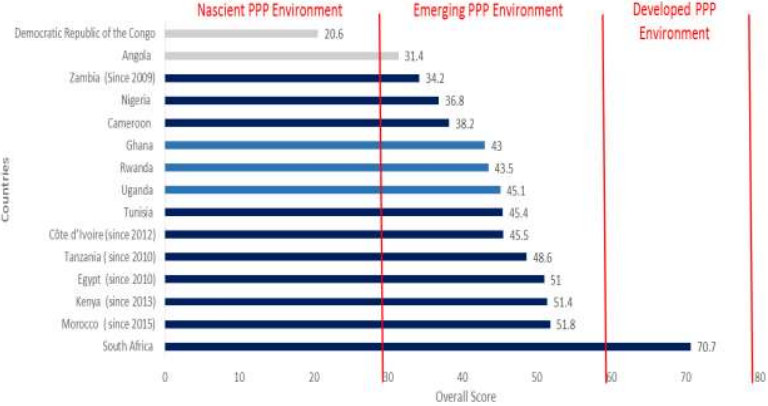


Figure 2: EIU Overall Scores - The 2015 Infoscope evaluating the PPP environment in Africa
Source: The Economist, The Intelligence Unit (EIU): Evaluating the environment for public-private partnerships in Africa-The 2015 Infrascope, 2015.
____________________________________________________________________________________
11 See Annex 2 in Volume 2 of the Inception Report: PPP in the Global Context (Some Recent Lessons from a literature review)
12 World Bank PPIA: PPPs Institutional Capacity Building in the UEMOA Region - https://ppiaf.org/program/building-public-private-partnerships-institutional-capacity-uemoa-region
13 Evaluating the Environment for Public-private Partnerships in Africa, The 2015 Infrascope-
14 A more depiction of the regional context will be part of the in-depth literature review to give an overview of the PPP enabling environment and markets in Africa based on the PPIAF-PPI database.