Current institutional and policy framework
96. A PPP Central Unit was established by the Ministry of Finance in 2006 as the main entity responsible for the initiation and implementation of PPP projects in Egypt. The Unit drafted the PPP law and initiated PPP projects in parallel. The 2010 PPP Law made the establishment of the PPP Central Unit official. It provides that the Minister of Finance stipulates the structure of the unit, while the Executive Regulations of the Law determine the administrative and financial framework for operations. This includes the Unit's relationship with other public organisations, its operational system and employee remuneration. In practice, the Unit is increasingly involved in the negotiation and execution levels of PPP bids and contracts. The law also provides that PPP "satellite units" are to be established, whenever necessary, within the different administrative authorities.
97. The law provides that a Supreme Committee for Public Private Partnership Affairs shall be formed and chaired by the Prime Minister. The PPP Supreme Committee is notably responsible for setting an integrated national PPP policy, endorsing use of the PPP structure for administrative authority projects, monitoring the financial resources allocation to meet obligations resulting from PPP contracts, issuing rules and general criteria for PPPs, and endorsing standard PPP contracts for use in different sectors.
98. The PPP Central Unit is to provide technical, financial and legal expertise to the PPP Supreme Committee as well as to the PPP satellite units. It is responsible for setting and following up on procedures for the tendering and conclusion of PPP contracts, as well as their execution. In addition, the Unit is responsible for preparing and publishing studies, information and statistics in relation to PPP projects, both locally and internationally, and for the selection of advisers for the tendering and contracting of PPP projects. The consent of the PPP Unit is necessary for the development and granting of PPP projects in Egypt, and the Supreme Committee for PPP Affairs must approve PPP tenders.
99. Further policy work is still needed on promoting and implementing a long-term PPP programme, raising awareness, and training public servants, especially in line ministries. Allocating further resources to the PPP Central Unit would reduce delays in project approval and execution.
Figure 5. Successful PPP projects in focus countries (2005 to today)
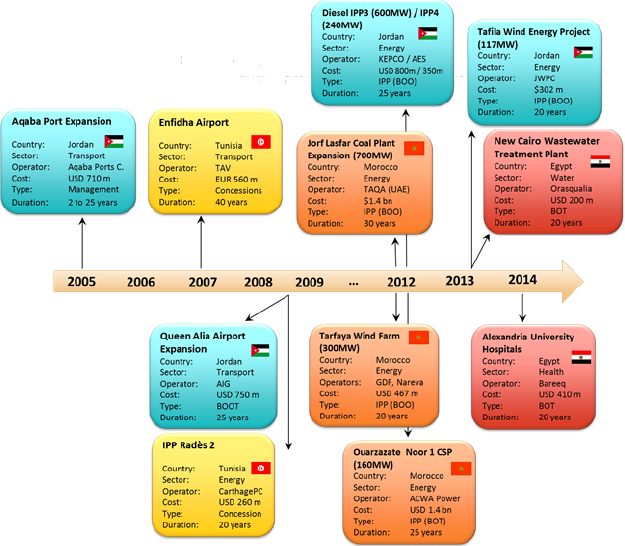
Source: OECD (2014)