Analysis of Results
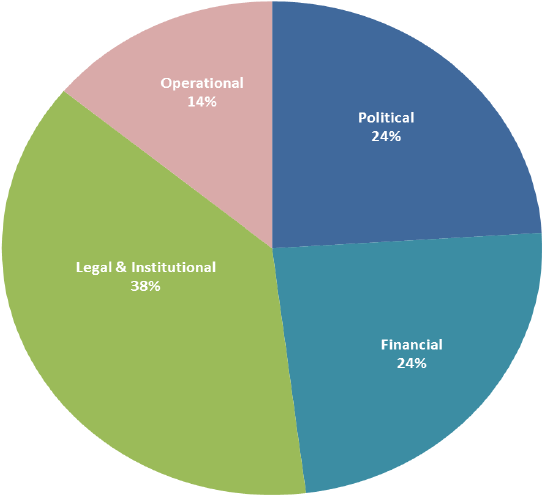
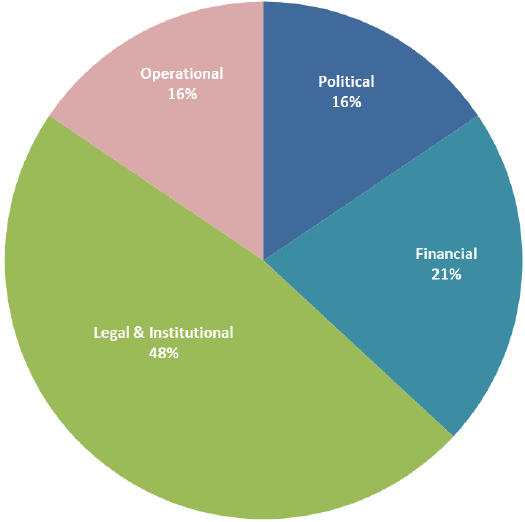
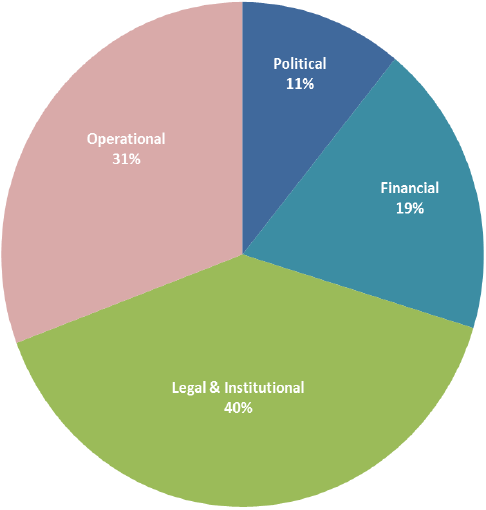
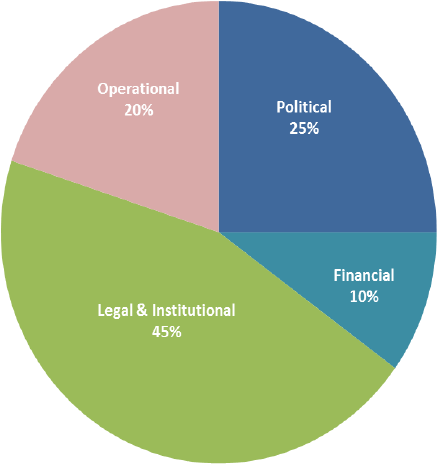
126. In each of the focus countries, legal and institutional risks are the most frequent barriers identified. Together with operational risk, legal and institutional barriers make up the majority of obstacles encountered, with a low of 52% in Egypt, 64% in Jordan, 65% in Tunisia and a high of 71% in Morocco. This is consistent with the major findings of the handbook but runs contrary to the view sometimes expressed that political risk is the most important factor inhibiting investment in the region. Political risk is cited as a barrier in a low of 11% of projects in Morocco, rising to 16% in Jordan, 24% in Egypt and 25% in Tunisia, the percentages for the latter two reflecting political events since 2011.
127. These results should be seen in a positive light. Political risk, real or perceived, cannot be changed quickly. However, the tools to address legal and institutional barriers to investment are within the hands of government and can be addressed much more readily than perceptions of political risk. What these results suggest, is that governments can have a real impact on private sector investment in infrastructure by focusing on reforms in areas such as project scoping and preparation, capacity, interagency cooperation and legal and institutional frameworks. Not coincidently, the proposals for reform contained in this publication mirror these priorities.
Egypt: Barriers to Private Participation in Infrastructure
EGYPT | |||||
Risk categories | Barriers to Private Infrastructure Investment | Frequency | Relevance* | Ability to mitigate* | |
(number) | (%) | ||||
Political | Political & Civil Disturbance | 10 | 20% | High | Low |
Corruption & Lack of transparency | 1 | 2% | |||
Public Perception & Social Opposition | 1 | 2% | |||
Change of Law & Breach of Contract | na | na | |||
Financial | Concessional Funding (lack of private funding) | 4 | 8% | Medium | Medium Low |
% Transfer of Funds | na | na | |||
Foreign Exchange (inc. devaluation risk) | 3 | 6% | |||
Counterparty Risk (lack of sovereign guarantee) | 5 | 10% | |||
Legal & Institutional | Project Scoping (incl. contract design & risk allocation) | 7 | 14% | Medium | Medium High |
Government Capacity | 3 | 6% | |||
Interagency Coordination | 4 | 8% | |||
Bidding Process | na | na | |||
Legal Framework (incl. permits & licensing) | 5 | 10% | |||
Operational | Land Availability and Ownership | 4 | 8% | Low | High |
Choice of Location | 1 | 2% | |||
Construction Risks | 1 | 2% | |||
Social & Environmental Risks | 2 | 4% | |||
Egypt: Barriers by frequency of occurrence
|
Source: OECD (2014)
Jordan: Barriers to Private Participation in Infrastructure
JORDAN | |||||
Risk categories | Barriers to Private Infrastructure Investment | Frequency | Relevance* | Ability to mitigate* | |
(number) | (%) | ||||
Political | Political & Civil Disturbance | na | na | Medium Low | Low |
Corruption & Lack of transparency | na | na | |||
Public Perception & Social Opposition | 3 | 16% | |||
Change of Law & Breach of Contract | na | na | |||
Financial | Concessional Funding (lack of private funding) | 2 | 11% | Medium High | Medium Low |
% Transfer of Funds | na | na | |||
Foreign Exchange (inc. devaluation risk) | na | na | |||
Counterparty Risk (lack of sovereign guarantee) | 2 | 11% | |||
Legal & Institutional | Project Scoping (incl. contract design & risk allocation) | 2 | 11% | Medium Low | Medium High |
Government Capacity | 2 | 11% | |||
Interagency Coordination | na | na | |||
Bidding Process | 2 | 11% | |||
Legal Framework (incl. permits & licensing) | 3 | 16% | |||
Operational | Land Availability and Ownership | 1% | 5% | High | High |
Choice of Location | na | na | |||
Construction Risks | na | na | |||
Social & Environmental Risks | 2 | 11% | |||
Jordan: Barriers by frequency of occurrence
|
Source: OECD (2014)
Morocco: Barriers to Private Participation in Infrastructure
MOROCCO | |||||
Risk categories | Barriers to Private Infrastructure Investment | Frequency | Relevance* | Ability to mitigate* | |
(number) | (%) | ||||
Political | Political & Civil Disturbance | na | na | Medium Low | Low |
Corruption & Lack of transparency | na | na | |||
Public Perception & Social Opposition | 4 | 11% | |||
Change of Law & Breach of Contract | na | na | |||
Financial | Concessional Funding (lack of private funding) | 7 | 19% | Medium High | Medium Low |
% Transfer of Funds | na | na | |||
Foreign Exchange (inc. devaluation risk) | na | na | |||
Counterparty Risk (lack of sovereign guarantee) | na | na | |||
Legal & Institutional | Project Scoping (incl. contract design & risk allocation) | 2 | 6% | Medium High | Medium High |
Government Capacity | 5 | 14% | |||
Interagency Coordination | 2 | 6% | |||
Bidding Process | 1 | 3% | |||
Legal Framework (incl. permits & licensing) | 4 | 11% | |||
Operational | Land Availability and Ownership | 6 | 17% | Medium Low | High |
Choice of Location | na | na | |||
Construction Risks | 1 | 3% | |||
Social & Environmental Risks | 4 | 11% | |||
Morocco: Barriers by frequency of occurrence
|
Source: OECD (2014)
Tunisia: Barriers to Private Participation in Infrastructure
TUNISIA | |||||
Risk categories | Barriers to Private Infrastructure Investment | Frequency | Relevance* | Ability to mitigate* | |
(number) | (%) | ||||
Political | Political & Civil Disturbance | 2 | 10% | High | Low |
Corruption & Lack of transparency | 3 | 15% | |||
Public Perception & Social Opposition | na | na | |||
Change of Law & Breach of Contract | na | na | |||
Financial | Concessional Funding (lack of private funding) | 2 | 10% | Medium - High | Medium Low |
% Transfer of Funds | na | na | |||
Foreign Exchange (inc. devaluation risk) | na | na | |||
Counterparty Risk (lack of sovereign guarantee) | na | na | |||
Legal & Institutional | Project Scoping (incl. contract design & risk allocation) | 3 | 15% | Medium - High | Medium High |
Government Capacity | 1 | 5% | |||
Interagency Coordination | 2 | 10% | |||
Bidding Process | na | na | |||
Legal Framework (incl. permits & licensing) | 3 | 15% | |||
Operational | Land Availability and Ownership | 2 | 10% | Medium - Low | High |
Choice of Location | 2 | 10% | |||
Construction Risks | na | na | |||
Social & Environmental Risks | na | na | |||
Tunisia: Barriers by frequency of occurrence
|
Source: OECD (2014)