CASE STUDY 2 BANGKOK'S SKYTRAIN (BTS): BACK ON TRACK DESPITE EARLY STRUGGLES
Commonly known as the BTS, Bangkok's Skytrain initially only covered 23.5 km of track in the center of Bangkok and has since expanded to a combined route length of about 39 km consisting of 36 stations along two lines: Sukhumvit and Silom. The BTS opened in 1999 and is the only rail infrastructure project out of seven projects in the Seventh Plan Urban and Regional Transport (SPURT) established in 1991. Back then, SPURT considered the use of private concessions to develop urban transport infrastructure to alleviate the chronic congestion problems (and air pollution) that densely populated Bangkok faced. There were four different government agencies leading various concessions with total projects valued at nearly $8 billion.35
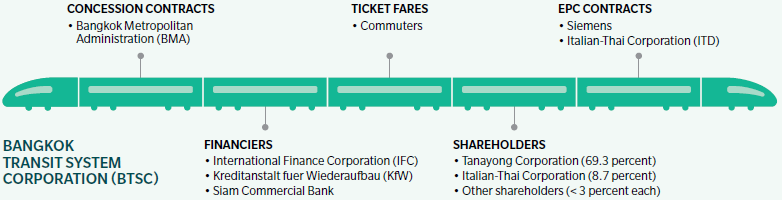
Tanayong Corporation, a Thai real estate company, won the bid for this project and subsequently created a project company, the Bangkok Mass Transit System Public Company Limited (BTSC). The financing package was approximately $1.4 billion and was financed solely by the private sector - $650 million in equity with the remaining in debt that came largely from International Finance Corporation (IFC), Kreditanstalt fuer Wiederaufbau (KfW, a European development bank), and Thai banks (Siam Commercial Bank led the transaction). The long-term debt for the project was agreed in 1997 with a debt service coverage ratio that reflected the ridership forecast of 650,000 riders per day for the project - it was estimated that BTSC would recover its costs within the first 10 years with a 16 percent rate of return given the contract provisions.36
• Full concession: a Build-Operate-Transfer (BOT) scheme with a 30-year concession agreement; any extension request must be made three years before the concession expiry date
• The project company, BTSC, receives all advertising revenue and revenues from right-of- way (on a distance-based tariff regime) with no funds provided by the government for operating the transit system. The government was responsible for providing the right-of-way and assisting in the relocation of utilities along the route during construction
• Fares were based on a formula incorporating the domestic Consumer Price Index (CPI), exchange rate fluctuations and variations in US interest rates - and translated to a 7 percent increase in fares for a 5 percent increase in inflation
• The concession agreement contained the fixed price, specified delivery date, performance standards, and required the main private sector partner to maintain at least a 51 percent stake in BTSC
• Other provisions included were: dispute resolution through arbitration; full-fare renegotiation due to various events (for example, force majeure, macroeconomic shocks)
EXHIBIT 16: BANGKOK SKYTRAIN (BTS) PROJECT STRUCTURE
Source: APRC analysis, United Nations