HEADING TOWARDS A GREEN FUTURE?
Many governments are driving a renewable energy agenda due to cost and emissions advantages and international pressure stemming from the Paris Agreement's Intended Nationally Determined Contributions (INDCs).# These imperatives include enhancing energy security, reducing the need for imported fuels, conserving a nation's natural resources, and cutting down on carbon emissions. A number of Asian Governments have introduced incentives (e.g. tax incentives, FiT, energy production payments) to support growth in this area and to encourage more investment.
Examples of proactive government action include the Vietnamese government approving a renewable energy development plan to increase electricity production by renewables from 3.5 percent in 2010 to 5 percent by 2020 and 11 percent by 2050 after ratifying the Paris agreement.41 Additionally the Thai government, in its new power development plan (PDP) 2015-36, aims to reduce its dependence on gas-powered generation from around 70 percent to 40 percent by 2036, with a shift towards renewable sources.42
When the economics of a project or investment is influenced significantly by FiT guarantees, extra consideration should be extended prior to investment. In the Philippines a recent FiT across a number of clean energy sources was only guaranteed up to a set capacity. This meant that a number of projects which became operational after the capacity had been reached were no longer able to access the FiT rates upon which investment decisions had been based.43
EXHIBIT 18: EXAMPLES OF ELECTRICITY AND POWER PROJECTS
THAI BINH THERMAL POWER CENTER 1,800 MW (VIETNAM)
| PROJECT DETAILS: Project involves the the construction of a 1,800 MW thermal power complex in Thai Binh which will comprise of two power plants: Thai Binh 1 (600 MW) and Thai Binh 2 (1,200 MW). Construction works began in 2011 and are expected to be completed by end 2017 |
| PROJECT STAGE: Execution PROJECT VALUE: $3.07 billion PROJECT OWNER: PetroVietnam Power Corporation (PV Power); Vietnam Electricity (EVN) PLANNING AUTHORITY: Ministry of Industry and Trade, Vietnam EPC CONTRACTOR: Marubeni Corporation; Petrovietnam Construction Joint Stock Corporation (PVC) |
|
| ||

TANJUNG JATI B COAL-FIRED POWER PLANT EXPANSION - CENTRAL JAVA (INDONESIA)
| PROJECT DETAILS: Project involves the expansion of an existing coal-fired power plant by adding two power generations with capacity of 660 MW each. Construction works began in 2008 and were completed by 2012 |
| PROJECT STAGE: Construction completed PROJECT VALUE: $2.60 billion PROJECT OWNER: PT. Central Java Power (Sumitomo Corporation) PLANNING AUTHORITY: Ministry of Energy and Mineral Resources, Indonesia EPC CONTRACTOR: Sumitomo Corp., Wasa Mitra Engineering |
|
| ||

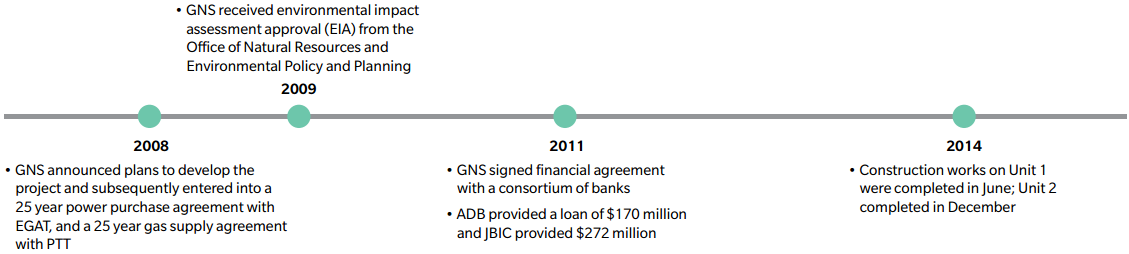
NONG SAENG GAS FIRED POWER PLANT 1,600 MW - SARABURI (THAILAND)
| PROJECT DETAILS: Project involves the construction of a 1,600 MW natural gas-fired combined cycle power plant, comprising of two units with 800 MW each. Construction works on Unit 1 were completed in June; and on Unit 2 completed in December |
| PROJECT STAGE: Construction completed PROJECT VALUE: $1.19 billion PROJECT OWNER: Gulf JP NS Company, Limited PLANNING AUTHORITY: Ministry of Energy, Thailand EPC CONTRACTOR: Sino-Thai Engineering & Construction Public Company Limited |
|
| ||
Source: APRC analysis of data from Construction Intelligence Center
_______________________________________________________________________________
# The Paris Agreement deal is the world's first comprehensive climate agreement where all countries agree to work to limit global temperature rise to well below 2 degree Celsius, with efforts to limit the increase to 1.5 degree Celsius