Current Account Deficits and Financing
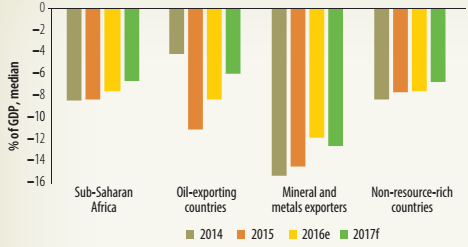
The current account balances of oil exporters are improving, helped by the pickup in commodity prices (figure 1.3). Oil exports are rebounding in Nigeria on the back of an uptick in oil production. In metal exporters, the positive impact of an improvement in metals prices is being offset by a rise in investment-related imports. Current account deficits remain high in several non-resource-rich countries (including Rwanda and Uganda). In these countries, capital goods imports have also been strong, reflecting ambitious public investment agendas. Capital inflows in the region are rebounding from their low level in 2016, which saw foreign direct investment fall and Eurobond issuance decline.
| FIGURE 1.3: Current Account Balance
| The current account balances of oil exporters are improving. |
FIGURE 1.4: Sovereign Bond Spreads
| Sovereign spreads have generally narrowed in the region; a notable exception is Ghana. |
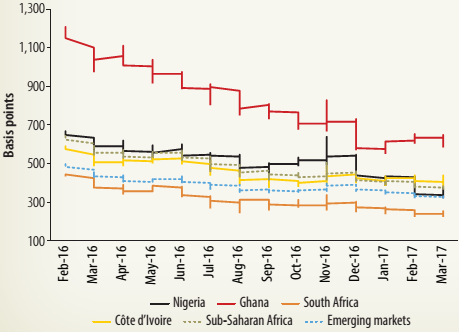
A strengthening of cross-border flows this year should help finance the still-elevated current account deficits. Gross foreign direct investment in Nigeria edged up in the fourth quarter of 2016, after declining in the first three quarters. Nigeria was able to tap the Eurobond market twice at the start of the year, reflecting improved investors' sentiment. More broadly, in a global environment characterized by low financial market volatility and increased investor risk appetite, sovereign spreads have generally narrowed across the region, with the notable exception of Ghana, where spreads rose because of concerns about fiscal policy slippages (figure 1.4). Sovereign spreads widened on South African debt in the wake of recent political developments and credit rating downgrade.