Exchange Rates and Inflation
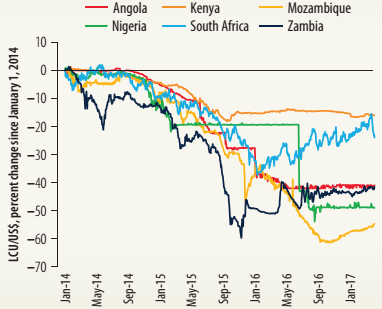
The rebound in commodity prices and improved growth prospects in some countries have helped stabilize commodity exporter currencies (figure 1.5, panel a). However, with the Nigerian naira and Angolan kwanza remaining fixed against the U.S. dollar, the imbalance in the foreign exchange market remains substantial in both countries. Among metals exporters, the Congolese franc depreciated sharply against the U.S. dollar in the second half of 2016, with weakness continuing in 2017, reflecting heightened political uncertainty as well as loss of foreign reserves in the Democratic Republic of Congo. A debt crisis in Mozambique sharply lowered the value of the metical against the U.S. dollar in the second half of 2016, and the currency remains weak. Annex 1B explores foreign exchange market pressures in Sub-Saharan Africa.
Inflation in | FIGURE 1.5: Exchange Rate and Inflation, Selected Countries a. Exchange rate
Source: Bloomber, Haver Analytics, World Bank Note: LCU= local currency unit |
b. Inflation: Selected countries
|
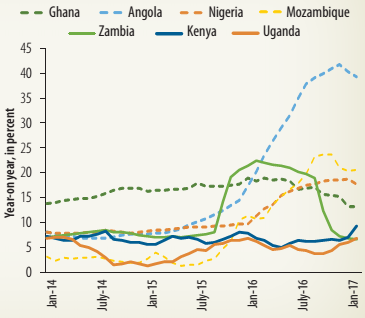
Inflation in the region is gradually decelerating from its high level in 2016, but remains elevated (figure 1.5, panel b). Although a process of disinflation has started in Angola and Nigeria, inflation in both countries remains high, driven by a highly depreciated parallel market exchange rate. Inflation eased in metals exporters, because of greater currency stability and lower food prices due to improved weather conditions (Namibia, Zambia). In Mozambique, inflation was in high double digits in February. In non-resource-intensive countries, inflationary pressures have picked up in East Africa, as the drought led to an increase in food prices-notably in Kenya. However, in countries where the drought has been less severe, inflation has remained within the central banks' targets. Inflation continues to be low in most CEMAC and WAEMU countries, reflecting the stable peg to the euro. The low inflation environment in Tanzania, Uganda, and Zambia allowed their central banks to cut interest rates at the start of the year. Bank of Ghana also cut its policy rate. Although inflation in Ghana remains in double digits, it has narrowed from over 19 percent in 2016, to around 13 percent in January.