Growth Resilience Revisited
Overall, the difficult economic conditions facing African countries in 2015 and 2016 have taken their toll on the economic resilience of the region. In the October 2016 issue of Africa's Pulse, 45 Sub-Saharan African countries were categorized into four groups based on the comparison of their average annual GDP growth rates during 1995-2008 and 2014-16. We revisit the categorization by using growth rates for 2015-17. This more recent period better captures the resiliency of countries to the commodity shock and difficult economic conditions and to the adequacy of policy response. The thresholds used to classify the countries remain the same: top and bottom terciles of the average annual growth rate of the 45 countries between 1995 and 2008-that is, 5.4 and 3.5 percent, respectively. The latest data reveal that only seven countries are seeing growth rates above 5.4 percent in 2015-17. The seven countries exhibiting resilience are Côte d'Ivoire, Ethiopia, Kenya, Mali, Rwanda, Senegal, and Tanzania (figure 1.8). These countries house nearly 27 percent of the region's population and account for 13 percent of the region's total GDP.
Côte d'Ivoire, Ethiopia, Kenya, Mali, Rwanda, Senegal, and Tanzania are the countries in the region showing resilience. | FIGURE 1.8: Taxonomy of Countries in Sub-Saharan Africa: GDP Growth in 2015-17 versus 1995-2008
Source: World Bank staff calculation based on the WDI database. |
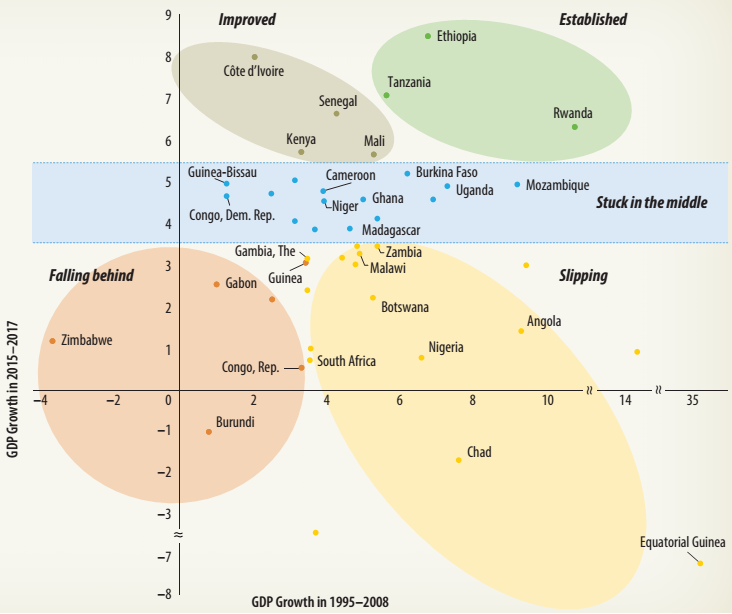
Several countries that were resilient in our earlier analysis are less so now: Benin, Cameroon, the Democratic Republic of Congo, Mozambique, and Togo. Mozambique's growth trajectory has been derailed by the rapid deterioration of the country's debt position, which has eroded investor confidence, sharply depreciated the currency, and prompted a tightening of monetary and fiscal policy. The deceleration in growth in the Democratic Republic of Congo reflects declining mining production and a fall in investment spending, combined with domestic political uncertainty. An additional seven countries, most of them resource-abundant countries (the Republic of Congo, Gabon, Mauritania, and Zambia), have moved into the slipping or falling behind category.
Resilient countries tend to enjoy robust and broad-based growth. Our previous analysis found that these countries generally have better macroeconomic management, and recent evidence continues to support this finding. These countries have managed to contain non-priority spending and mobilize domestic revenue, building fiscal space for investment and social spending. The size of debt relative to GDP is lower for this group of countries (averaging about 40 percent in 2016) compared with that of other countries in the region (54 percent). Inflation rates in resilient countries are lower than in other countries in the region, averaging 4 percent and 5.8 percent, respectively, in 2015-16.