High Trade Logistics Costs
Trade logistics costs remain high in the region, constraining the competitiveness of local firms. Lowering these costs can help countries to exploit the opportunities for trading in goods and services, globally and within the region.
| Trade logistics and intraregional trade in Sub-Saharan Africa are areas of untapped potential. So far, growth in regional trade has been limited. | FIGURE 1.10: Merchandise Exports of Sub-Saharan Africa, 2000-15
Source: World Integrated Trade Solution database 2017. | Growth in intraregional trade has been limited. |
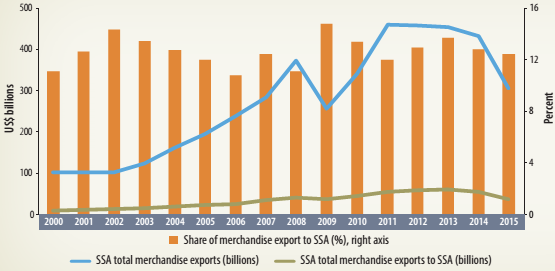
Although the total value of exports between African countries increased from $12 billion in 2000 to $38 billion in 2015, the average share of intraregional exports in total exports has remained about 13 percent (figure 1.10). This share is substantially smaller than intraregional trade among European Union countries (60 percent of total exports) and among East Asia and the Pacific region countries (46 percent).
There is enormous untapped potential for intraregional trade in Africa to increase and drive export diversification, job creation, and poverty reduction. For example, greater regional trade integration could bring the following benefits:
• Food security can be enhanced by increasing intraregional trade in staple foods and processed agricultural products (box 1.4).
• There are emerging opportunities for cross-border trade in basic manufactures, such as metal and plastic products that are relatively costly to import from the global market.
• There are opportunities to develop regional value chains to drive global exports of manufactures, such as phosphates for fertilizers and regional processing of nickel and copper.
• There is considerable potential for cross-border trade in services, such as health, education, and business services.
| BOX 1.4: | Increased regional trade can reduce the wedge between producer and consumer prices for essential food products, increasing the welfare of consumers in structural deficit areas where food prices are high, and that of producers in surplus areas where farm gate prices are relatively low. One way to quantify the effect of barriers that limit trade is to evaluate what would be the increased distance that would increase costs equivalently to crossing a border. Recent analysis of the prices of maize, rice, and cowpeas found that crossing the border between Niger and Nigeria is equivalent to pulling these countries 639 kilometers further apart; the Nigeria-Chad border effect is equivalent to adding 594 kilometers. In addition, the segmentation of markets in Africa increases the volatility of food production prices. In every West African country, the volatility of within-country production is greater than that of the region, and production is imperfectly correlated across countries. The implication is that greater intraregional trade would help stabilize prices in individual countries in the face of local shocks. This would hold more strongly for the larger pan-African continental market. Hence, deeper integration with larger regional markets can reduce the impact on the poor of the price effects from localized shocks. In addition, lower trade barriers and better trade infrastructure allow faster and more efficient response to localized food shortages due to disasters of all types. a. Cervigni and Morris (2016). b. World Bank (2012).. |
However, the high cost of connecting to markets is a fundamental detriment for African producers. It is estimated that intraregional trade costs are around 50 percent higher in Africa than in East Asia, and are the highest of intraregional costs for any developing region.1 Achieving the trade potential of the region will require substantial improvement in the quantity, quality, and range of trade-related transport and logistics services. Various studies have shown that, in general, less developed and expensive trade logistics lead to the following:
• High overhead costs for manufacturers. The World Bank's 2011 report on Light Manufacturing in Africa showed how poor trade logistics increase production costs (often wiping out the advantage of lower labor costs) and lead to long and unreliable delivery times, making local firms in Africa uncompetitive in regional and global markets.
• Inefficiencies in logistics services that undermine agricultural supply chains. Continued productivity improvements in agriculture will require enhanced access to modern inputs, seeds, fertilizers, and pesticides, often through imports. Investment in new inputs requires access to markets and fast, efficient, and predictable transport and logistics. Increasing the productivity of the agricultural sector, and the resulting growth of the agro-processing sector, will be crucial for continuing rural development; however, it will be constrained if the trade logistics services available in the country are of poor quality and high cost.
• Continuation of the current logistics systems in Africa, which impose very high costs on small firms participating in trade. Thriving regional trade in staple foods and manufacturing, including processed agricultural products, will require efficient consolidation and distribution services if small firms are to benefit from economies of scale in transportation.
Although the region has made considerable progress in addressing the logistics constraints to trade, there is still much more to be done to reach the levels of other developing countries and help African firms compete on an equal footing in regional and global markets. Several countries in Sub-Saharan Africa have made some of the largest gains in trade logistics, as measured by the World Bank's Doing Business and Trading Across Borders indicators. For example, between 2009 and 2014, nine of the top 10 reformers globally in the trade indicator were in Sub-Saharan Africa, and 70 percent of the economies in Africa implemented at least one reform. Along corridors, there has been some success in removing roadblocks and reducing border-crossing times, with impacts on transport efficiency and cost, such as in East Africa.
However, Africa still has some catching up to do, compared with other regions, on broader measures of logistics quality, such as the World Bank's Logistics Performance Index, and in ensuring that poor people are connected to markets through efficient and reliable logistics services. The following are the key priorities for African countries as they seek to improve competitiveness and deepen regional integration:2
• Improvements in trade logistics need to facilitate trade not only along corridors to the main ports, but also across borders between African countries, to realize the potential from regional integration and regional sourcing of inputs in Africa.
• Improvements in physical infrastructure must be complemented by better policies and procedures applied to trade. Experience is increasingly showing that the largest impact often comes from the latter. Hence, there is a need to deepen the focus on simplifying trade rules and procedures, and ensure transparency and predictability in their implementation.
• Improvements in trade logistics are not just about goods in trucks and containers, although those are vitally important. These improvements are also about facilitating the movement across borders of people and services. The logistics of trade in services, whether it be issues related to virtual connectivity or mutual recognition of the qualifications of professionals, such as accountants, engineers, or health and education workers, require more attention to realize the enormous opportunities from trade in services.
• The political economy of reform is such that it is essential that the private sector is the main driver of change.
• Finally, benchmarking and measuring trade logistics performance are a critical part of any strategy that seeks to leverage trade, including regional trade, as a driver of diversification and poverty reduction. Monitoring is needed to ensure that (a) reforms are being implemented, and (b) the benefits of improved trade logistics are being passed on to producers and consumers in the form of a broader range of lower-priced and more widely available goods and services.
Governments in Africa can exploit a range of agreements and instruments to support the implementation of this reform agenda. Groups of like-minded countries in subregions in Africa can come together to address the logistics constraints that undermine mutual trade opportunities-such as is being done by countries in Southern Africa under the Accelerated Program of Economic Integration, and between the Democratic Republic of Congo and countries in the Great Lakes Region. Countries can enhance their efforts to implement the commitments to facilitate trade made through regional economic communities, as have the countries of the East African Community, and could leverage the Tripartite Agreement and the Continental Free Trade Agenda as vehicles to push a transformation agenda for trade logistics that prioritizes impacts on the poor.
Finally, global agreements, such as the Trade Facilitation Agreement, can be implemented in a way that ensures that the improvement of regional trade logistics accompanies efforts to improve connectivity to the global market.
_______________________________________________________________________________________________
1 Based on regional estimates from the World Bank-UNESCAP Trade Costs Database.
2 Huria and Brenton (2016).