Evolution of Real Gross Domestic Product per Worker in Sub-Saharan Africa after a Plunge in International Energy Prices
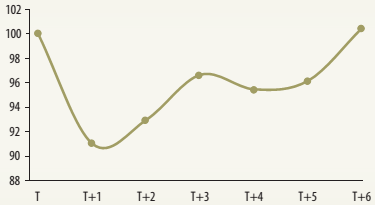
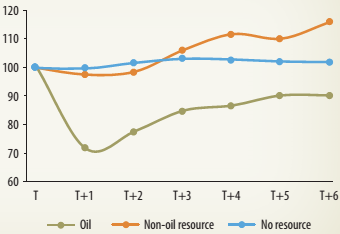
The behavior of real gross domestic product (GDP) per worker after a price plunge in the region and in country groups classified according to their extent of resource abundance is presented in figure 1A.2. For the region, output per worker drops about 9 percent in the first year, and takes five years to recover to the pre-shock level (figure 1A.2, panel a). Looking at the regional aggregate masks differences across country groups (figure 1A.2, panel b). As expected, output per worker among oil-rich countries deteriorates sharply (with a median peak to trough of about 25 percent). Among non-oil-rich countries, the drop in income per worker is not as pronounced, but it is protracted. Overall, resource-rich countries in the region (oil and non-oil) fail to recover to pre-shock levels during the next six years. Non-resource-dependent countries had a barely negative impact after the commodity price bust. In an environment of lower energy prices, these countries managed to build some growth momentum.
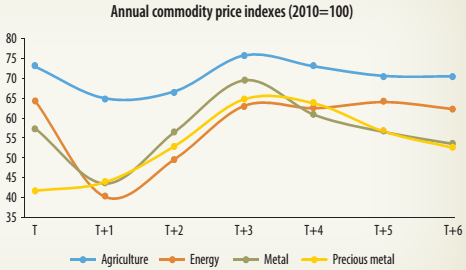
Output per worker drops about 9% in the first year and takes five years to recover to the pre-shock level. | FIGURE 1A.1: Evolution of Commodity Prices after an Energy Price Plunge in Sub-Saharan Africa
Source: World Bank. Note: Period T represents the year previous to the energy price plunge. |
In non-oil-rich countries, the drop in income per worker is not as pronounced. | FIGURE 1A.2: Behavior of Income per Worker after an Energy Price Plunge in Sub-Saharan Africa (weighted average, index) | |
a. GDP per worker
| b. GDP per worker, by group
| |
| Source: Penn World Tables 9.0 (Feenstra, Inklaar and Timmer 2015). Note: All real output per worker figures are rescaled to 100 for year T (the peak year before the energy price plunge). | |