Infrastructure Gap, Financing Gap
The evidence shows that there are severe infrastructure bottlenecks to be addressed in Sub-Saharan Africa, and the potential growth benefits of addressing these bottlenecks are large.
However, fast-paced infrastructure catch-up requires the mobilization of resources for financing. The private sector has fairly limited involvement in the various infrastructure sectors across the region, except in South Africa. If the additional spending that is needed to close the infrastructure gap falls on the public sector, it imposes a heavy burden. First, the countries have limited domestic resource mobilization. Total government revenues fall short of 20 percent of GDP in many countries in Sub-Saharan Africa. Second, in the presence of scarce resources, governments must compare the benefits of investment in infrastructure relative to those of other pressing demands (such as education and health, among others).
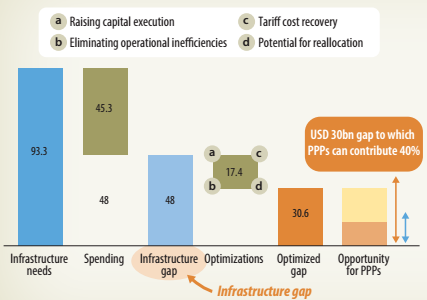
Narrowing the infrastructure gap requires financing. It has been estimated that the infrastructure needs of the region exceed US$93 billion per year over the next decade. That amount is about 15 percent of the region's GDP (Foster and Briceño-Garmendia 2010). To date, less than half that amount is being provided: actual investments in infrastructure amount to US$45 billion annually-with more than half being funded by the public sector. This leaves a financing gap of US$48 billion per year. Estimates show that about one-third of the infrastructure gap can be met through operational optimization, thus narrowing the gap to US$31 billion (5 percent of the region's GDP). Public-private partnerships could potentially represent 40 percent of this optimized gap, with an amount of US$12 billion annually, or about 2 percent of GDP (figure 2.28).10
When the government drastically reduces growth-promoting spending (for example, in infrastructure, education, and health care), the present value of future government revenues falls by more than the immediate improvement in the cash deficit (Easterly, Irwin, and Serven 2008). Targeting short-term government cash flows introduces an anti-investment bias into fiscal discipline, which can turn into lower future growth and, hence, adverse consequences for the sustainability of public finances (Serven 2007).
Financing public infrastructure investment will indeed depend on a country's fiscal position. The real effects, more generally, would depend on how public investment is financed and the existing levels of debt and various taxes. Christie and Rioja (2012) developed a two-sector endogenous growth model to examine the impact on long-term growth of the composition and financing of infrastructure spending. The authors find that: (a) raising taxes to fund public investment may promote long-run growth in an environment where tax rates are not high; (b) public investment promotes growth if the investment is funded by restructuring the composition of total public spending, if tax rates are high; and (c) debt-financed public spending can have adverse effects on long-run growth if the spending results in rising interest rates and debt-servicing costs.
| Finally, efforts toward fiscal discipline have often been related to persistent declines in infrastructure investment. Reduced public investment is not a cause of concern, as long as it reflects improved efficiency of spending, improved public procurement, and reduced red tape and corruption, among others. If private and public investment are close substitutes, retrenchment of the public sector may have to be fully offset by private sector entry without adverse effects on service delivery. However, this has not been the case in many infrastructure sectors in developing countries. With reduced budgets, the government may try to crowd in private investment. When combined with better commitment to regulation, rising private investment in infrastructure will improve access, affordability, and the quality of infrastructure, and enhance public savings (Estache 2005). Box 2.5 presents the World Bank Group's "cascade" approach to deploying resources based on a hierarchy of financing conditions. | FIGURE 2.28: Infrastructure Financing Needs in Africa (US$ billions)
Source: Foster and Briceño-Garmendia 2010. | Estimates show that about one-third of the infrastructure gap in the region can be closed with operational optimization. |
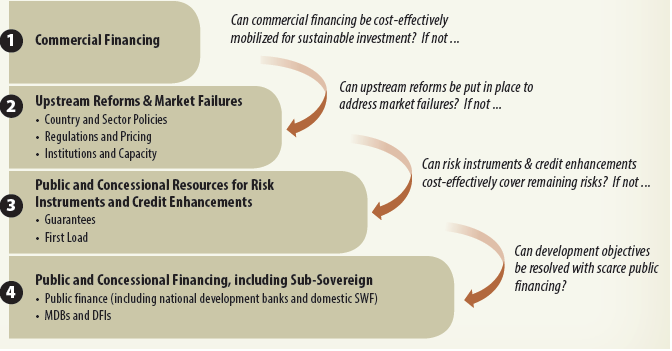
| The World Bank Group estimates that about 50 percent of infrastructure needs in developing countries can be financed on a commercial basis. To maximize private investment in infrastructure, the World Bank Group has formulated a strategy called a "cascade" approach. This approach deploys resources based on a hierarchy of financing considerations. It examines a set of questions at each level of investment decision to promote the efficient use of public and concessional resources, crowd in commercial capital, and minimize public debt burden. The cascade approach has four levels of diagnosis (figure B2.5.1). The starting point is to identify whether a development program can be financed on commercial terms. When diagnosed as commercially viable and cost effective without government guarantees, then the investment is not a priority for concessional or public financing. When commercial financing is not viable, due to perceived risks or market failures, upstream reforms to strengthen policies, regulations, and institutions and capacity are needed. If risk and cost remain high, governments need to explore the possibility for lowering financing costs by deploying concessional and public resources in risk-sharing instruments, such as guarantees. Finally, where commercial financing is not cost-effective or viable, despite sector reform and risk mitigation, governments need to mobilize public and concessional resources. | BOX 2.5: The Cascade Approach to Finance Infrastructure |
| Countries determine whether and how to follow such an approach. The role of the World Bank Group is to assist governments to assess options systematically based on the approach. The cascade approach will allow a more systematic emphasis on upstream reforms at the national and sector levels, and maximize the development impact of concessional and public resources. FIGURE B2.5.1: The Cascade Approach to Infrastructure
Source: World Bank, "A Cascade Decision-Making Approach Infrastructure Finance: Guiding Principles for the World Bank Group." Note: DFIs = development finance institutions; MDBs = multilateral development banks; SWF = sovereign wealth fund. | |
___________________________________________________________________________________________
10 Recently, the African Development Bank launched an initiative, called Program for Infrastructure Development in Africa, to increase infrastructure provision. The main objective of the program is to build a strategic network for the development of regional and continental economic infrastructure over 2012-40.